Eddy brings floods

The floods?  In case you missed it, here’s the CDO wash at E. Wilds Road yesterday around 5:30 PM:

Eddy?

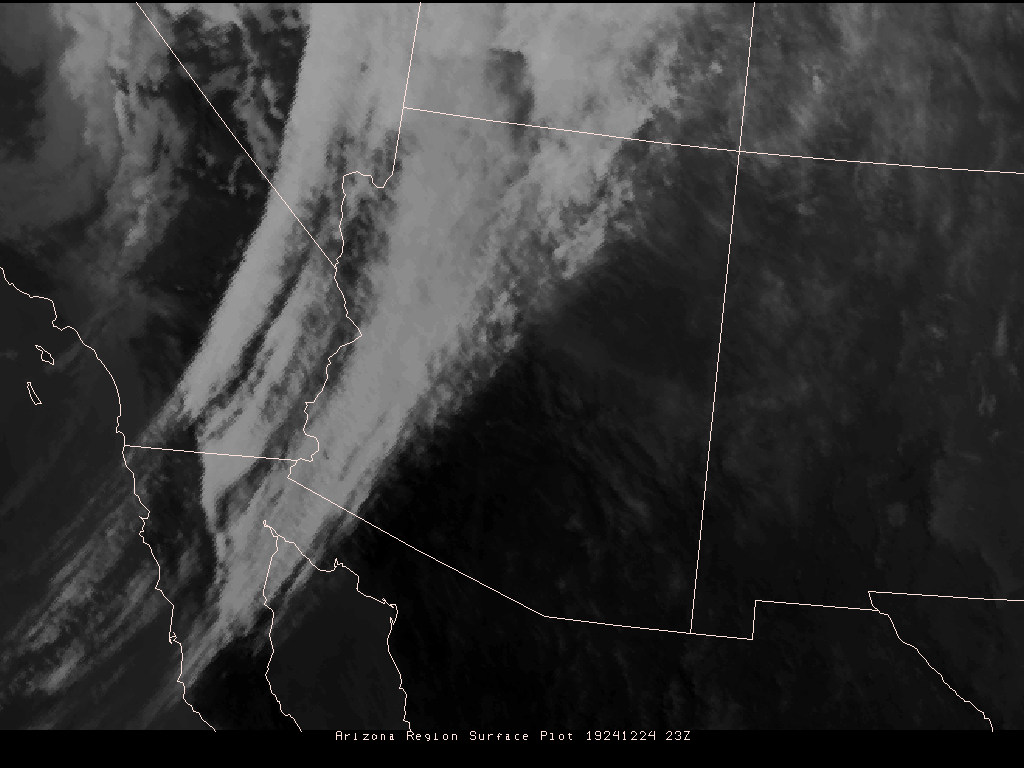
As in “Cyclonic Eddy”, one that had a long history of mayhem and drought relief as far back as in southern Texas, before it worked its drought-bustin’ magic in Arizona yesterday.  Here’s the trail in the water vapor imagery (you will need a LOT of bandwidth for this satellite loop since its 204 hours long!)

Or, you could take my word for it that this drought buster “Cyclonic Eddy” spun up in east Texas in late June (the 28th).Then it wobbled around Texas, exiting around Del Rio bringing welcome rains there.   Then it ambled across northern Mexico toward Guaymas, across the Sea of Cortez-Gulf of Cal to southern Baja, before a weak Pacific trough altered its path and sent it speeding northward right over Tucson yesterday.  Its remnant is located over Flagstaff at 4 AM this morning, still racing northward.

So, with a flood of tropical air ahead of it, and Eddy to work with it, we got a sample of a day in Florida; unusually low cloud bases meaning the clouds are chock full of water, and Eddy helping to cluster them together into behemoth complexes, ones that released all that water here and there in long pounding rains.   There was even a waterspout-like funnel like the ones they see all the time in the Florida Keys!

What an amazing day.  Mr. Cloud Maven person took more than 200 photos because he was out of control; the “executive  function1” of the brain, that function that weighs whether impulsive actions are really that good for you, continuously being overridden by docu-photo impulses.  (For those of you more interested in how your brain works than in the clouds I am going to describe, you can go here (Executive function in the brain Science-2011-Diamond-959-64.) ((Now, this article is behind the Science mag “pay wall”, so you’ll have to have some loose change before you can read it; don’t read it otherwise.))  (((I can’t believe all the information I am giving you today!!!)))

Continuing….I don’t think in four years I have seen clouds as large as these blow up so early just anywhere they felt like.  Here are some examples, starting with the first amazing one (to me) because it was out over the flatlands, and yet HUGE for 9 AM in the morning!

Actually it was 9:33 AM. Still it was magnificent in its grandeur at any time of the day.
12:21 PM. Suspicious line of clouds develops S-W of Catalina. Whenever you see a line like this, something is going on, like a windshift below the clouds, causing them to be solid over a long distance.


12:35 PM. Suspicious line persists, clouds fattening up. Surely contain precip at this point, but no sign of a shaft yet.


12:36 PM. Wisp of shaft begins to fall from this spectacular line of Cumulus congestus.
12:38 PM. Bombs away. La Cholla and Moore Rd. crossing is going to receive 2.80 inches in the next hour!
12:42 PM. Shaft matures and widens rapidly. Continuous thunder heard, emanating from high in turrets that are converting into Cb calvus *bald” to Cb capillatus (with “hair”-fibrousness)l


12:46 PM. Now looking like something I would expect to see in the Phillipines. Gigantic rainshaft, arcus cloud beginning to form above the outflow winds.
12:54 PM. Shaft continues to broaden, and propagate outward toward Catalina! The rest is history and I am running out of room.


Now for some 24 h rain totals for the period ending late yesterday afternoon when the rains had ended.  This from our Pima County Flood control folks and their many gages.  They love measuring rain!  Its great.

24h totals for July 4th, 2012

Also go here for even more rain totals!  From the U of A, these historic data for the 24 h ending at 7 AM today.

______________________________

68 F dewpoint in Catalina now; 0.31 inches overnight

68 F dewpoint at TUS, too.  With this kind of dampness, it should be an exciting day with clouds topping the Catalinas, and you know when that happens, its another sign of really heavy rain in the area.  In fact, we have a little strip of Stratus fractus along the base of the Catalina’s now (5:29 AM).

Let’s go to the National Weather Service’s web page and see if they are excited about today… Yes!  They are pumped, with “green” shading designating those areas of southeast Arizona in a NWS flash flood watch!

Here’s the 4 AM map below, courtesy of our University of AZ Wildcats National NCAA Baseball Champions Weather Department.    What a great final game that was!  (You can get their latest map here.)

After a mostly disappointing day, an unusual summer day in which there were no clouds being launched off the top of Mt. Sara Lemmon, and temperatures were unusually “cool”, there was finally a strong, whitish brightening of the sky to the east, with darkening to the northeast beyond Charoleau Gap, as the sun slid below the horizon.

And if you were looking at the Weather Underground (now having been absorbed by The Weather Channel in some kind of capitalistic power grab)  web page for the Catalina area, you saw that the brightening beyond the Catalina Mountains yesterday evening was due to the anvils of an approaching complex of Cumulonimbus clouds.  But as we know, they don’t always make it after dark coming from the east, only on some days.   They often fade away, or only produce sprinkles.

It began to rain pretty hard right at 9:30 PM, but there had been no lightning preceding it.  I was surprised at how hard it was initially raining, thinking earlier that the rain was going to be old stratiform rain from dead Cumulonimbus remains, very steady and light, maybe adding up to just few hundredths. Then “BLAM” this brilliant bolt nearby and two huge booms of thunder setting off a car alarm near us.  How great that was!  Rain continued to fall until about 2:30 AM.  That lack of lightning suggests the rain producing cell was building right over us, finally climbing to heights and with updrafts strong enough to produce the first lightning.  Sprinkling again now (for a couple of minutes) from Altocumulus opacus clouds…  Very unusual to have morning rain here as you know.

You can get the regional values of rain here from the Pima County Alert gage network and also here from the U of A’s rain measuring network.   Three Alert locations had over an inch, and many more in the U of A network!  What a great start to the summer rain season!

Here’s a reprise of yesterday’s clouds starting with mid-afternoon and the remarkable absence of Cumulus boiling off the Catalinas.  Instead, small Cumulus (“humilis”) were scattered helter skelter around the area as though there were no mountains.
3:04 PM
3:44 PM.  Also, looking toward the sun you could see a lot of smoke in the air here, a pretty sight.
7:17 PM. Sky looked threatening, but at this time they were just shallow clouds, ones whose cloud tops were below the ice-forming level.


Below, “the brightening” as Stephen King might put it, showing that deep clouds were around, and they were approaching from the east.  The anvils, well above 30,000 feet, are still in full sunlight, and the sun is shining through the thin, probably haze-free air up there.  Its undiminished light remains white when striking those cloud tops, not having had the shorter wavelengths scattered away by aerosols (until the sun subsides farther below the horizon).

Late bloomers and a dry day; but plentiful rains dead ahead

Here’s a brief reprise of yesterday in photos.  Expect a similar day today, late rising Cu over the Catalinas, isolated Cumulonimbus off on the horizon, probably NW-NE over the Mogollon Rim, and to the distant SE-S. None are expected to make it here.

12:33 PM. Small Cumulus finally begin appearing over Mt. Lemmon.
4:02 PM. Really haven’t done much, though some turrets poked up to the ice-forming level. Arrows show some ice falling out of an old, evaporating turret.
4:03 PM. Massive anvil appears over the horizon to the SE-S giving hope something could still happen.
5:52 PM. Getting closer!


7:16 PM. Rain complex stays to the S-SW, but provides a nice summer scene with occasional lightning.
7:37 PM. Cumulonimbus capillatus incus (one with an anvil) punctuates the sunset. Somebody got dumped on out there.


Don’t forget to go to the movies to re-live yesterday here, courtesy of our University of Arizona Wildcats.

The rain ahead

One of the great model forecasts of our time came out yesterday from the 12Z global data, and has been pretty much replicated in its results from the new data that came in yesterday at 00Z. These runs have had plentiful rains in SE AZ for just about every day after our little hot dry spell, and both of those US runs with all that rain ahead are supported by model runs by the Canadians using their brand of the Euro model. Here’s the US full run from last night, whilst the Canadian run can be found here.

What’s intriguing is that a tropical wave, sometimes called an “inverted trough” because its upside down compared to our winter troughs, is foretold to move into the State about the 4th of July.   An inverted trough would bring extra organization and clustering of Cumulonimbus complexes, which means bigger areas of rain, often accompanied by a large stratiform rain shield that produces hours of rain.  It is also true that these can be our most damaging storms.

OK, this big event is “out there”, and you know that this blog is going to jump on the wetter side of the model forecasts.  Still, its pretty darn exciting to think of days of scattered showers beginning in early July, and maybe a real drencher just ahead around th 4-5th.  The best part is that even if that doesn’t happen, we are embedded in a flow pattern that would keep up that a hopeful possibility of rain day after day, into mid-July.


Tracey

That’s about all we can muster in Catalina these days it seems, just a trace of rain.  Several drops came down out of stratiform debris clouds overhead around 7 PM.  If you weren’t outside, or driving, you would never have noticed.  I guess you could call those dull icy clouds with virga streaks hanging down from them “Nimbostratus cumulonimbogenitus” (derived from Cumulonimbus clouds) if you really want to know.

At the bottom of those were dark looking Stratocumulus droplet clouds that gave a sense of drama and portent, but they were only so dark because it was near sunset, there was a higher layer above them, and likely the high droplet concentrations in our clouds deflected what little light was reaching them back from where it came from (scattered and absorbed that bit of light).  They were not dark looking,  in this case anyway, because a deep Cumulus turret was piled up on top of those bases.  The patchy areas of light and dark help tell you that those dark bases are going to lead to zip.

6:15 PM yesterday.

Below is a reprise of the whole dramatic day, one that had a little fakery in it where for a time it appeared it was going to be a dry day, but ended up with some tremendous storms in the vicinity.

If you don’t want to look at stills, go here to the U of A time lapse movie.  The dust storm goes by at about 15:20 if you can make out the tiny time hacks.  This is a great movie and really shows how much “action” there is up there, even in those Ac cas clouds shown in the second shot.


8:36 AM.

The day started with promising heavy clouds at sunrise, then those thinned and disappeared, but there were also some great Altocumulus castellanus clouds that moved up from the S after that.

Those clouds, too,  thinned away as well under the blazing sun, and then our little Cumulus began to arise over the Catalinas, early again, just after 9 AM, a timing that is always filled with portent for a good storm day.

By mid-morning, some sharp turrets were “pluming upward” off the Catalinas, though those clouds were “behind” in size from where I thought they would be by late morning, shown next (11:45 AM shot).


11:45 AM.

Then awful things began to happen. These clouds started to stagnate in size or even wither over the next two hours! Clearly, drier air was moving in, a very discouraging thought.

While I was up on the rise at the Marana landfill to get a better look at the overall situation over the Catalinas, the stagnating Cumulus clouds began to erupt upward into Cumulonimbus clouds!   At the same time, a huge complex was moving toward Tucson from the S, one that was to shove a lot of dust up Oro Valley and into Catalina. I started to feel better, get excited.

Here are a couple of photos of that dramatic reversal of cloud fortunes:

2:15 PM, from the Marana landfill showing a cross section of the Cumulus clouds that were about to explode into thunderstorms.
2:44 PM. A large Cumulonimbus (capillatus) cloud had blown up over the Catalinas.
4:04 PM. Amid all the thunder and cloud to ground strikes, for a moment it appeared that those Cumulonimbus clouds would build westward from the Catalinas into Catalina. But no.
5:03 PM. The clouds did build out over Oro Valley and to the NW of Catalina. Here a huge, solid base tells you that a large updraft has coalesced with a ton of precip up there about to drop out. The back of the dump truck is rising now.
5:06 PM. Just THREE minutes later!
5:17 PM. A little after the main load had been dumped; some lightning for you in case you missed it.

Today?

Still enough water in the air for Cumulonimbus clouds here and there, but likely not so many as the past three days as we head for a HOT dry spell, as I am sure you all know about by now.


Early to rise

9:42 AM: Small Cumulus clouds first appeared over the Catalinas within a half hour of this shot.

These small fluffs of Cumulus clouds above Ms. Mt. Sara Lemmon, were the first indications that something good, and very different from the previous two days was going to happen yesterday.  These clouds appeared no less than 4 h earlier in the day (between 9 and 10 AM yesterday) than those first Cumulus on top of the Catalinas on the previous two days.

The correct emotional response due to this early rising for cloud maven juniors and doscents out there should have been excitement and anticipation;  that some big boys with long names (Cumulonimbus capillatus incus) were likely going to be around later in the afternoon and evening hours.  No weather maps needed!  See AZ Star for confirmation.

While we didn’t get a big dump right here in Catalina, we did at least get a dust-coagulating 0.02 inches. Here are the totals ending at 24 h from around the region from the Pima County Alert gages.  The most hereabouts was at the Santa Cruz River at Ina Road with 0.59 inches, with that storm shown in the photo at 4:25 PM below.

Today, with dewpoints once again being in the upper 50s, it should be the case that we see these early precursor clouds on top of Mt. Lemmon, and they will once again lead to the conclusion of a satisfying day of thunder and intense rainshafts, driven by 100 F plus temperatures.  It peaked at 106 F here yesterday in Catalina, and it was fairly cloudy when that temperature was recorded!  Pretty remarkable.

Here’s your NWS computer generated forecast for Catalina, foretelling similar temperatures for today.

Here are some later shots of those great clouds, and if you want the whole nine yards, go to the U of A time lapse movie here.  There’s a lot of rotation at the bottom of some clouds 1:03 before the movie finishes, and an indication of a rope-like funnel cloud, not too surprising given the instability of yesterday.

1:42 PM: Able to hear thunder for first time.
3:24 PM: Cumulus clouds begin piling up over Catalina.
4:23 PM. Eventually of those Cumulus congestus clouds reached ice-forming heights and produced our little 2 hundredths shower. By the time it reached Saddlebrooke, it had a visible shaft.


4:25 PM: While our little shower passed by, Marana and vicinity were getting the real thing in dumps of more than half an inch.
5:18 PM. Ditto to the NW where heavy rainshafts in this complex created a “haboob” that affected Casa Grande.
5:25 AM this morning: Stratoumulus with Cirrus and Altocumulus above greet the morning sunrise.


Maybe today, with plenty of clouds and heat, it will be our day to get the big dump and wash the dust off our desert plants.

The End.


Model trickeration, Dark Bluster, =s no rain!

You can see what didn’t happen here in the U of A time lapse movie.

I got pretty excited when the U of A Weather Department issued a special report yesterday morning on what the Beo Wolf cluster had come up with in terms of yesterday and today’s weather.  These kind of special, technical reports, ones that only I can read, not general people, except in the pictures and everybody can read those and can comprehend, are only issued during the best (worst storm) monsoon days.  So, it was VERY EXCITING for me to get in this special post in an e-mail.   The many model runs had some great thunderstorms and wind building up to the S and SE of us and roaring in across the Oro Valley-Catalina urban complex during the late afternoon and evening.  I was pumped.  SOMETHING was going to happen!

And, just as the models were thinking, “anvilation” (first photo) began to appear to the south through soiuthwest by late afternoon before the AZCats won the national NCAA Division I baseball title.  Sadly, that complex died out before getting here.

Then, over the Cat Mountains, things began to look more promising just before sunset (2nd shot).Cloud bases began looking more solid, not broken up into dark and light patches, and that solidity suggests an significant updraft over a wide area.  I thought, “Here it comes!”,  since those dark bases were moving off the Catalinas and toward us, possibly pushed by an outflow wind on the other side.  This kind of thing, as you know, happens all the time here.

But no, those bases fell apart, they were merely a phenomenon called “Dark Bluster” which nobody really understands, and the only thing that happened from those clouds was a light rainshower over by San Manuel I think, one that produced a weak rainbow (3rd shot).

Oh, well, at least the evening ended with a nice sunset and a national title.

Today?

Hit and miss showers/thunderstorms likely in the afternoon and evening hours again.  Nobody knows exactly where they will be so you’ll have to be watching.  Actually this is a pretty good deal for later June, often with no chances of rain at all.

Update at 9:17 AM:  Cumulus forming over the Catalinas!  This is about 4 h ahead of the past two days.  Is a darn good sign of more showers/thunderstorms today.

The End.

4:51 PM: Game about to start, complex of Cumulonimbus clouds stretches from S through SW of Catalina.


Two thunderstorms, but no rain here

12:35 PM. Remains of a Cumulus turret that had just reached the ice-forming level. The arrow points to the low concentration of ice crystals and snowflakes that formed in it.

A thunderstorm is in progress when you can hear thunder.  Yesterday, beginning at 1:20 PM, we were having a thunderstorm in Catalina due to those modest Cumulonimbus clouds on top of the Catalinas.   Here are those clouds, ones that streamed northwestward and died.  This first photo of an isolated, flat cloud is the remains of what was a bulging Cumulus congestus turret that sprouted over Mt. Lemmon.  It was of interest because at this time the tallest sprouts were just reaching the point where ice would form at noon to 1 PM yesterday.  Its really unusual to see a marginal ice-producing turret like this dead one in the first shot.  Such a cloud is of great interest to researchers studying the characteristics of ice formation since normally turrets ascend quickly through this initial ice-forming level to much lower temperatures, and the onset of ice temperature has to be estimated.

The rainshafts from these Catalina clouds were transparent (“Code 1”) the whole time they were producing, indicative of not much rain having fallen from them.

You can go here to the Pima County Alert site to see the rain totals hereabouts and in Tucson overall.  CDO Wash at Rancho Solano (just NE of Saddlebrooke) got the most, 0.43 inches, due to a cell that developed later and is shown below.

This same Cumulonimbus can be seen at the very left edge of the view on the great U of AZ time lapse movie for yesterday here.

As the day starts, you can also see the waves in the atmosphere rippling through those Altocumulus/Ciirrocumulus clouds we had in the morning.  Fascinating.

The next event was caused by the rush of winds from a strong cell near Marana that sent rain-cooled air pushing north into Oro Valley.  That push of air gave a lift and a life to a developing Cumulus over Saddlebrooke just north of us, and before long, out dropped the load of rain, with occasional thunder with it, too.  Here’s the “trigger cell” SW of Catalina with its rainshaft at the max which sent that rush of wind that in turn, pushed up the Cumulus over Saddlebrooke.

The full sequence of that Saddlebrooke cell is shown below.

3:45 PM. Strong rainshaft near Marana sent winds swirling northeastward to Catalina and helped trigger the Saddlebrooke cell.

Not a bad day yesterday–two thunderstorms in one day is always good–but less productive than hoped for here, always the case if there is less than an inch.

What’s ahead?

As you can probably feel, the humidity is still high. Dewpoints here are again in the upper 50s, quite juicy for AZ and that means another day of these sorts of clouds.  Yay!  I love photographing the bottoms of clouds, ones that are going to deposit a load, but before there is any sign of it coming out.  And we will all have a chance to do that again today.


4:30 PM.
4:33 PM.
4:35 PM.
4:39 PM.
4:45 PM.
7:37 PM. Missed the best part of this sunset due to preoccupation with the AZCat baseball game in Omaha. Go Cats!


Cumulonimbi sightings; can rain be far behind?

No.

Yesterday saw a gorgeous sight after our long cloudless spell; Cumulonimbus anvils approaching from the south-southeast in the later afternoon, our summer friends with their winds and rain squalls.  The bottom of those thunderheads disappeared before they arrived over Catalina, and were just anvils, that icy portion above 30,000 feet or so, but they harbinger a great rainfull day today as degree of moisture improves.  The dewpoint in Tucson was only 39 F yesterday at this time, and is now a robust 58 F!  Welcome water molecules!  This means that if you condensed all the water out of a cubic meter of air today you would get  about 8 grams while yesterday you would have only gotten about 4.5 grams, so almost a doubling of water content in the air swirling around us.

And with this, instead of having cloud bases at 14,000-15,000 feet above sea level (about 11- 12 KFT above us) as we did yesterday, they’ll be closer to 10-11 KFT above sea level, or 7-8 KFT above us (maybe even topping Ms. Lemmon).  This will mean that less of the precious rain falling out of those Cumulonimbus clouds today will evaporate before it reaches the ground.   And with that, some very dramatic skies later today.

Check the U of A local model here to see what the great “Beowulf Cluster” is thinking about rain today in AZ.  Looks good.  Note some favored areas just to the SW of us might get an inch of rain today! (But, don’t count on the EXACT placement of those strong rain areas; they’re often off by many miles.  Its just a good indicator of strong showers very near us today.)

The past two days have seen some rain fall in SE AZ, but the cloud bases were so high, not much reached the ground.  So, the chances of a significant rain here in Catalina this afternoon and evening are good, indeed.

Farther ahead…and remembering 1955.

The models are still making it look like a normal uptick in rain chances around the 4-5th of July, pretty usual for us here in Catalina, with a bit of a dry spell before that uptick in rain chances.

One interesting facet of the weather pattern these days is how a cold spring and summer in the Pacfic NW in 1955 translated into a bountiful summer rain season here.  This June will be one of the coldest/wettest ever in Washington State.  Many of you out there probably remember the great summer rains of 1955 and those string of hits by The Platters.  While weather never quite repeats itself, and there hasn’t been a group like The Platters back either,  its something to hope for, that is, that the cold in the NW, wet in AZ pattern will recur this summer.

Lots of complainers now in the Pac NW these days with the continuing rains and cool weather there as the longest day of the year has passed, the days beginning to shorten, with no sign of summer yet.

Here are a few shots of those approaching Cumulonimbus clouds from yesterday:

First Cumulus over Ms. Lemmon about 1 PM AST.
Just after 3 PM, first Cumulonimbus sighting, and its moving this way!
5:22 PM: Cumulonimbus complex moving this way, but looking like too much anvil cloud, not enough connecting clouds.
6:24 PM: Its gone, faded away as the afternoon heating faded and all the lower Cumulus were gone. Just an icy mass drifting toward us.
7:36 PM: a nice ice cloud sunset, but no chance of rain.

Our Catalina summer rains and when they come

Below is an updated chart showing the frequency of rain in Catalina from June 1st through September 30th.  These data are mostly the courtesy of Our Garden here in Catalina on Stallion Place, supplemented in the past few years by obs here on Wilds Road.  Thought you’d like to see this to get your day started thinking about rain. Its pretty self-explanatory, which saves me a lot of work.


For really pretty charts of temperatures and rain frequencies, go here to WeatherSpark, a very nice site.  No stations at our elevation and near us are available in their station list for Arizona, however.  We are, as you know,  very much affected by our higher elevation than those longterm stations around us like Tucson (rain increases in Arizona mainly with elevation) and because of our nearness to the Catalina Mountains which are a spawning ground for the summer showers that often affect us.

 The weather ahead

Models are still showing rain creeping into SE AZ tomorrow.  If nothing else, we should see some Cumulonimbus tops off to the SE by late afternoon or evening.

Here, from the U of WA, valid for tomorrow evening at 8 PM AST.  Note lightly colored regions in SE AZ:

Looking WAY out ahead, the NOAA spaghetti factory has turned out plots that make it seem like the summer rain season will get started for real (steadily) on July 4-5th, as suggested by the rain frequency chart above. Here what came out for 5 PM AST, July 5th, some 14 days from now that makes that seem likely.

Why?

Note that dark region to the north of Arizona, that region mostly located in Utah and Colorado.  This spaghetti plot/ensemble runs of the model after introducing slight errors or changes in “initial conditions” those at the very start of the model run.  That dark region represents a pretty strong signal in the data that our big fat anticyclone (at 500 millibars, around 20,000 feet here in the summertime) will be located in a favorable position for good rains here in southern Arizona.  The red lines are those lines that pretty much represent the boundaries of that high, and you can see that they are located to the south of us, as well as to the north.  In the summer, you want to be in a LOT of red lines to the south of the high, representing in this case, nice easterly flow with a lot of humidity in it across northern Mexico.

Looking forward to seeing some real rain, and how this plays out.

The End


Let’s the rains begin…

in southeastern Arizona/   Looks like the first chance for rain in sight from Catalina is on Friday,  a minimal beginning, but a beginning.

Thereafter, rain appears somewhere in AZ in last night’s model run from that ONE green pixel of rain over the Catalinas Friday afternoon-evening, everyday for the next 10 days!  Let the summer rain season begin!  BTW, if you would like the latest official government update on the summer monsoon, go here.  As you will see, there are no strong forcings that will help us figure out where it will be juicy or not.  So, expect somewhere around normal, but hope for MORE.

Test your map skills and see if you can find that green (indicating rain) pixel, forecast to “occur” between 5 PM and 11 PM AST on Friday:

The entire wonderful sequence can be found at IPS Meteostar here.

From the Washington Huskies version of the WRF-GFS model, this panel for Friday afternoon at 5 PM AST (more detail on that first chance of rain in those colored regions below).  Below is the rain expected in SE AZ between about 2 PM and 5 PM.  Sweet.  That whole sequence can be found here.

The End.