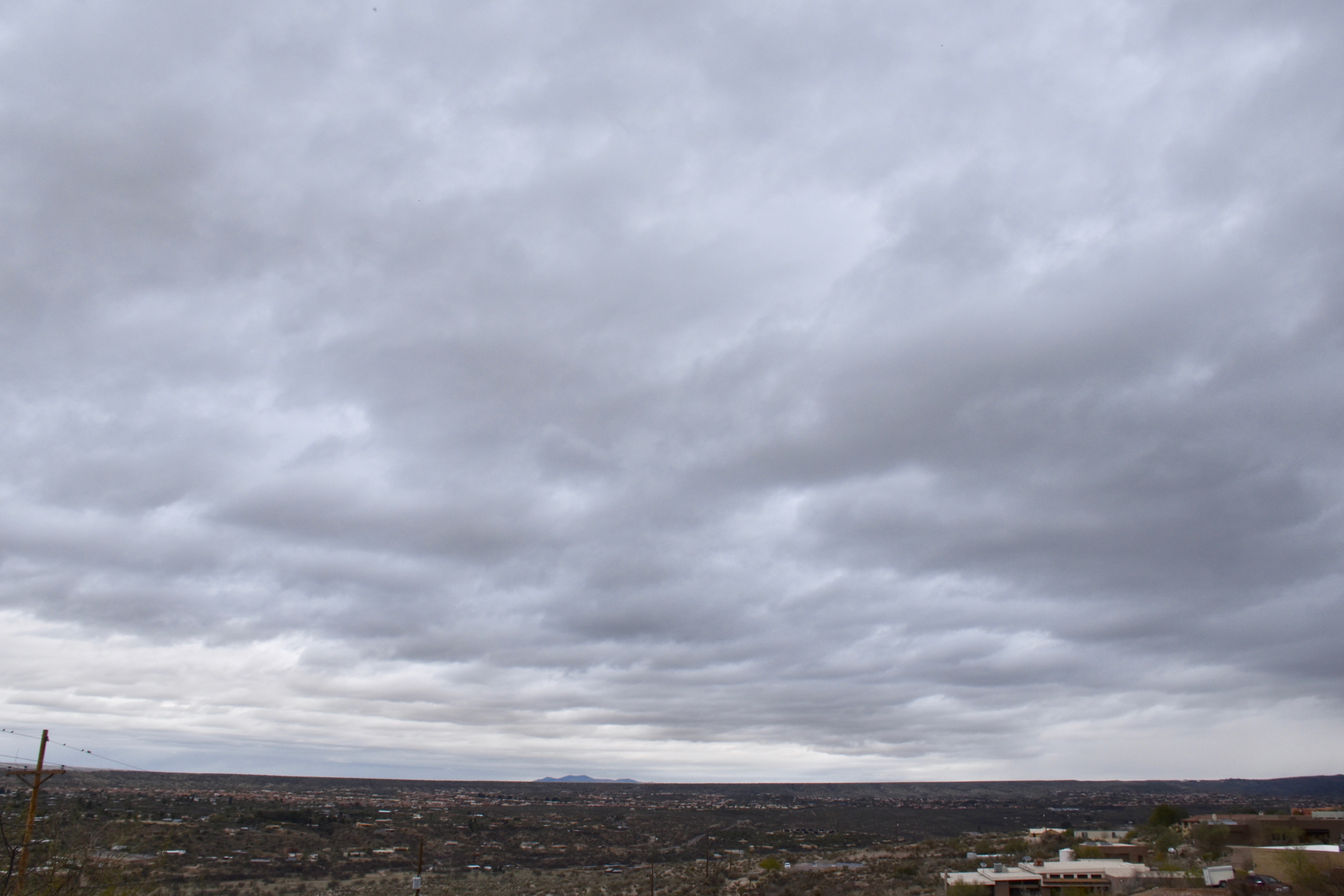
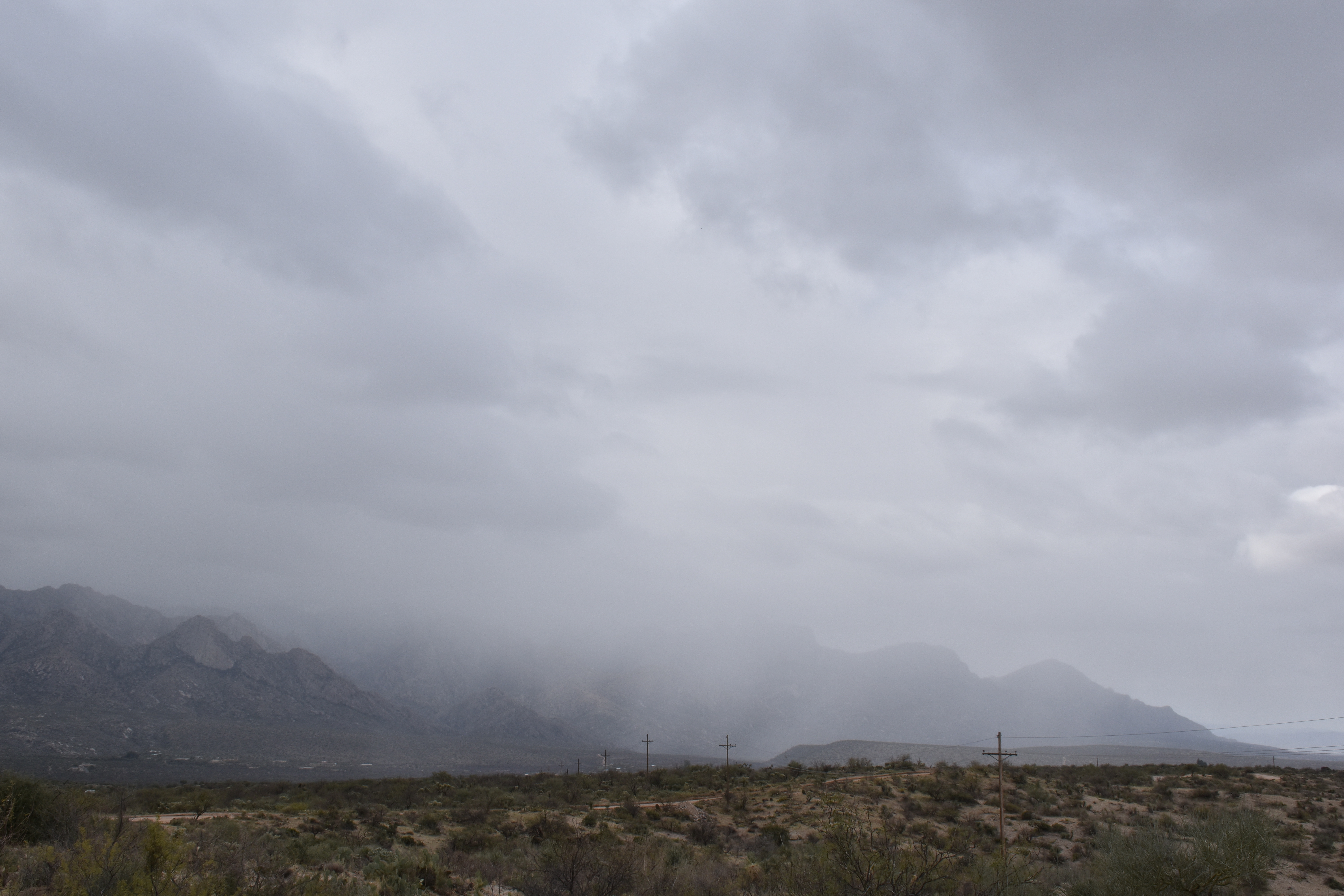
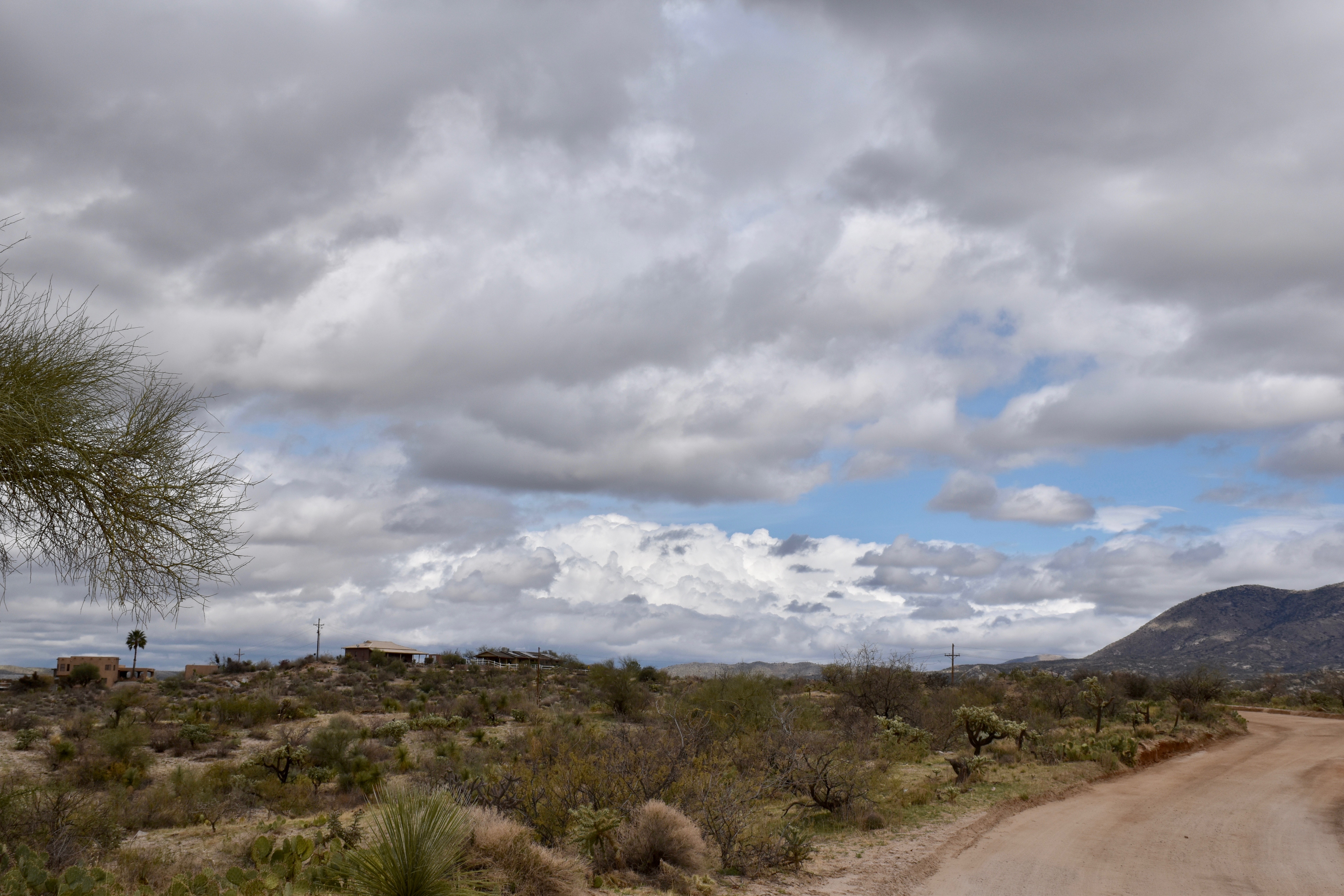
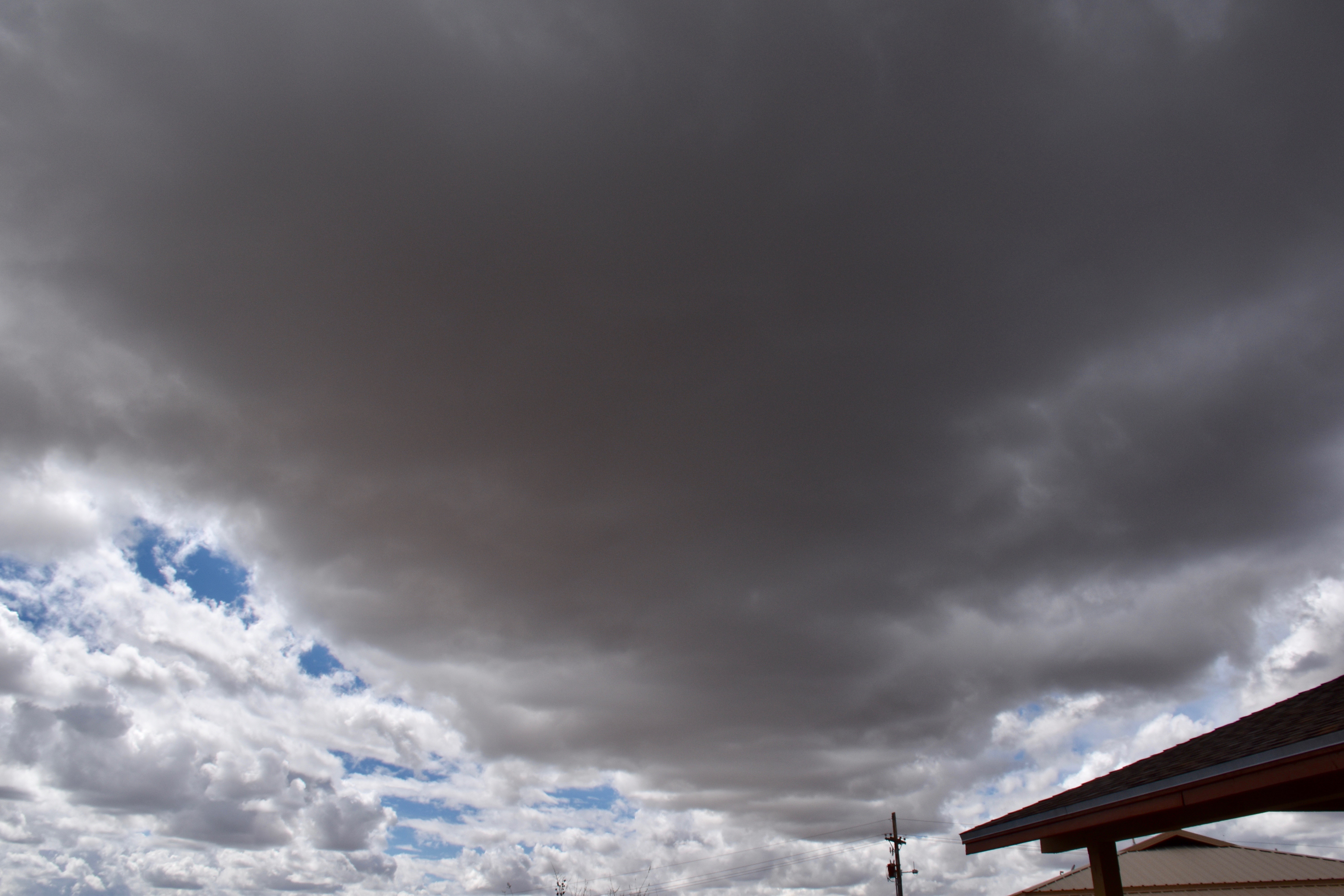
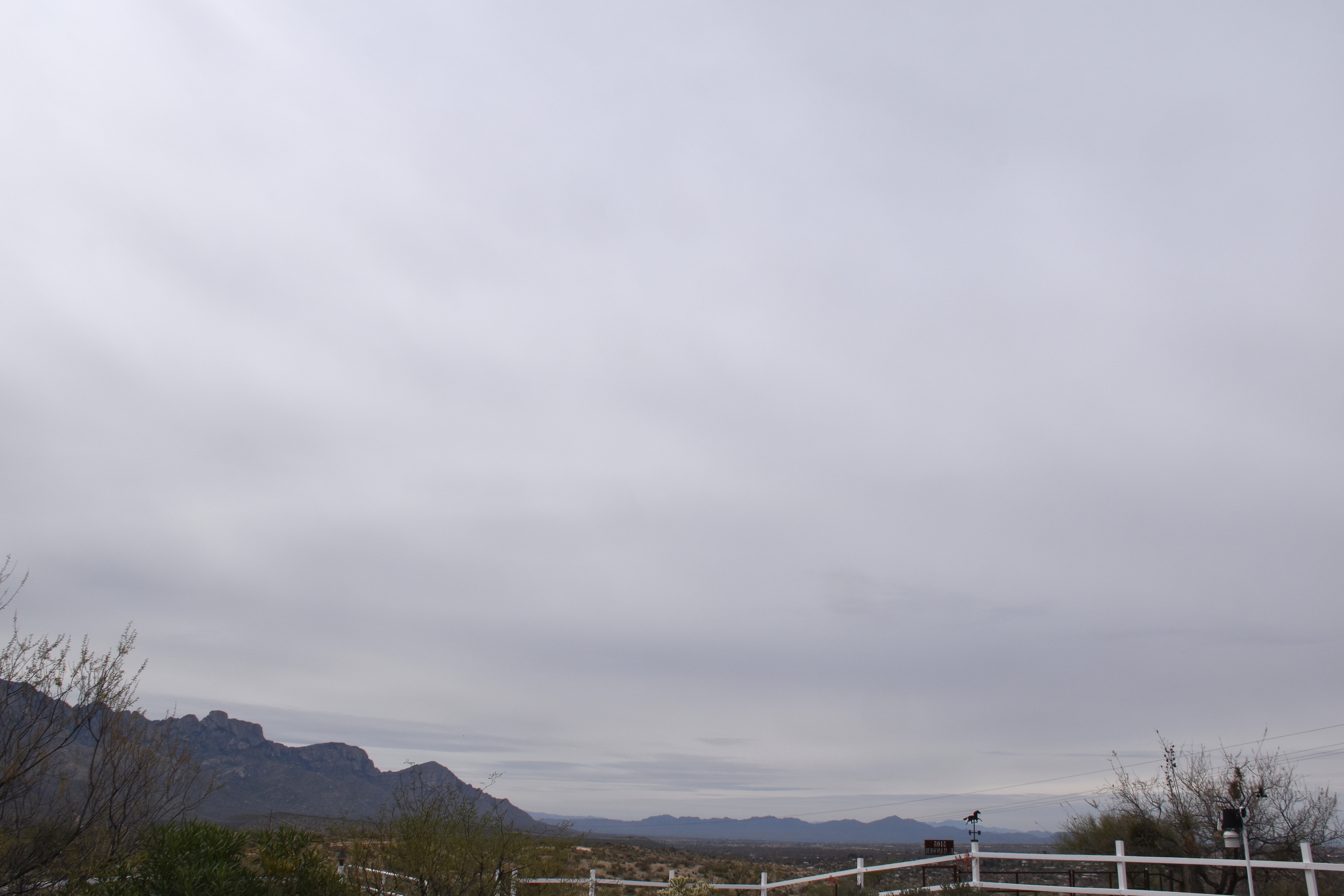
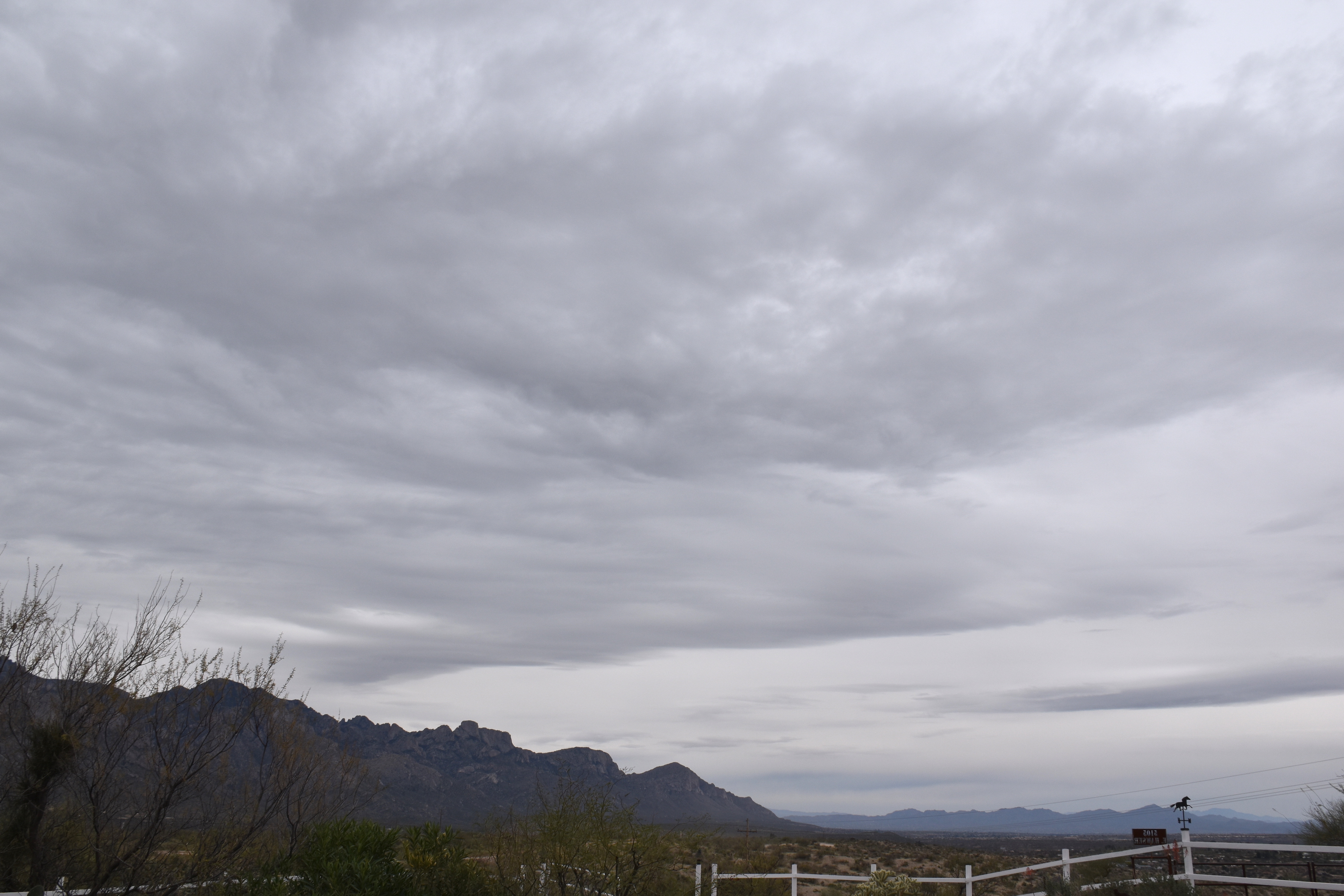
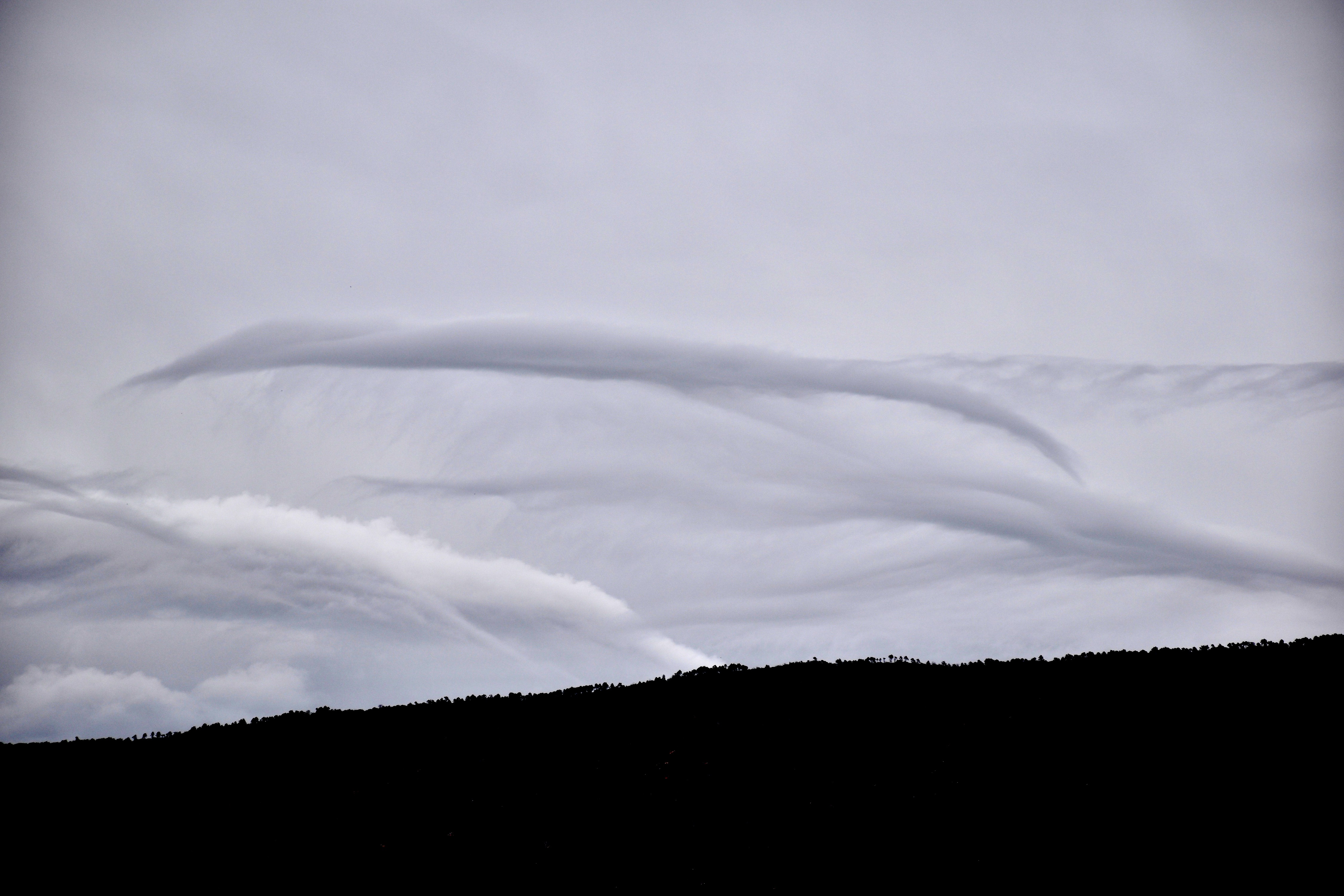
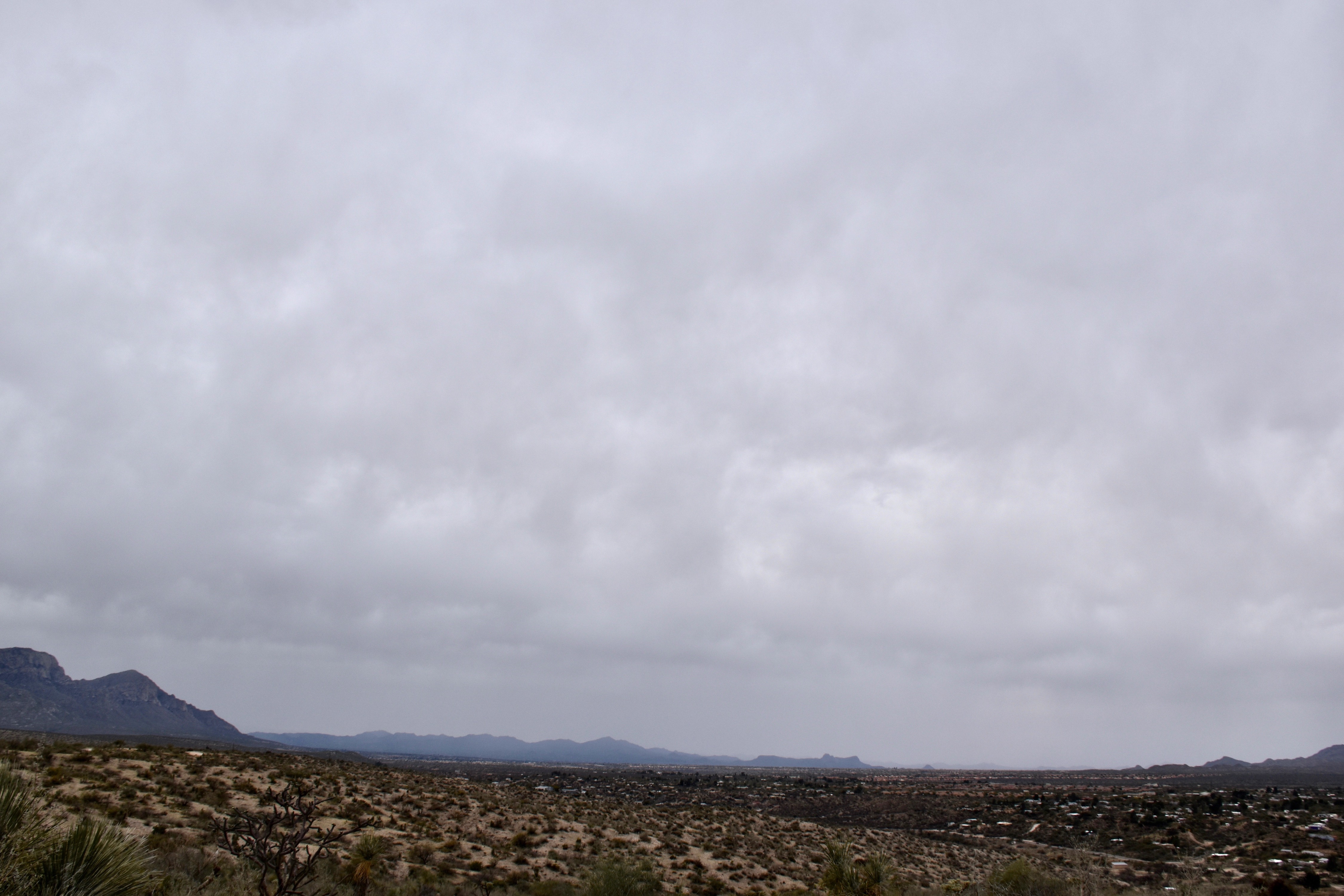
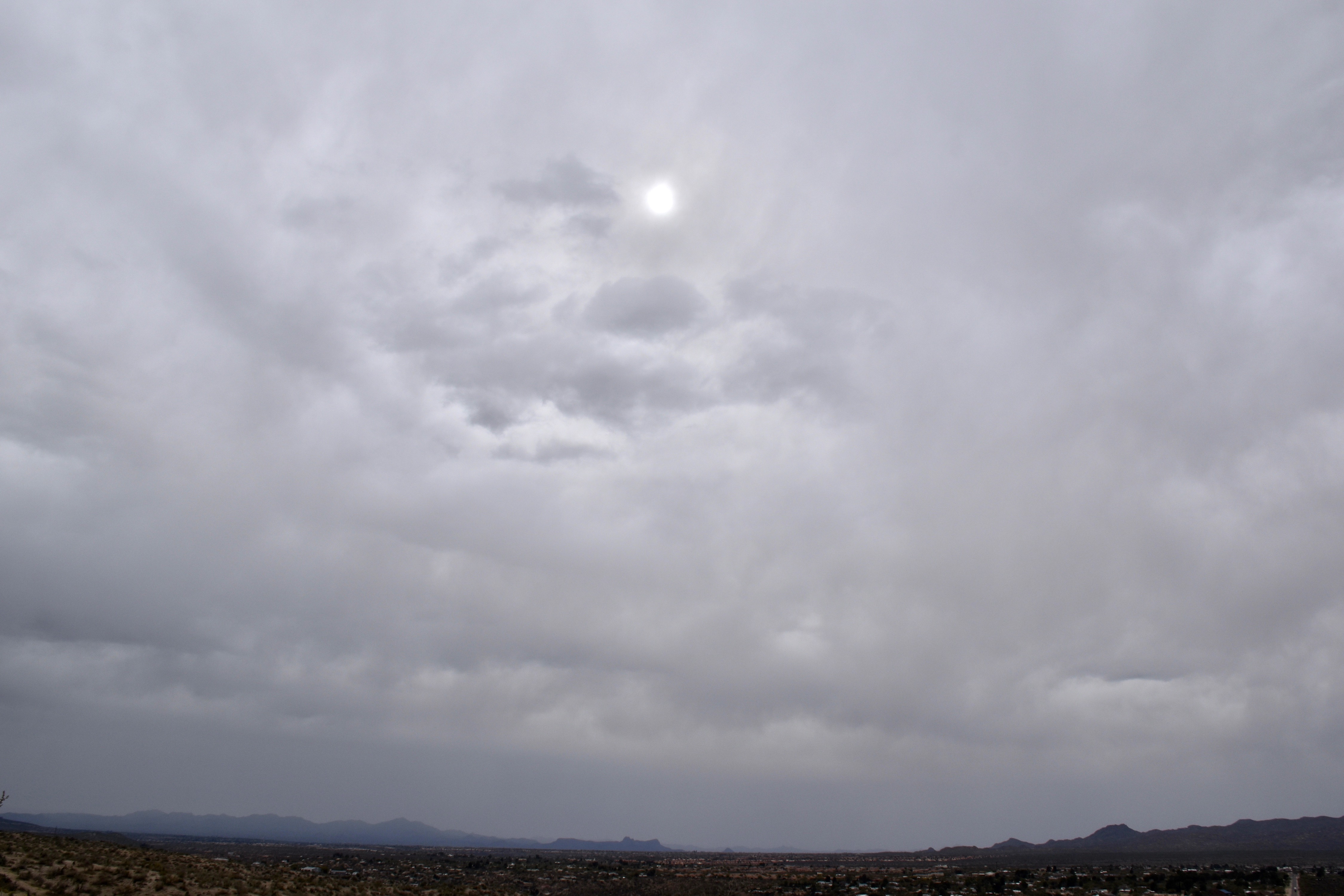
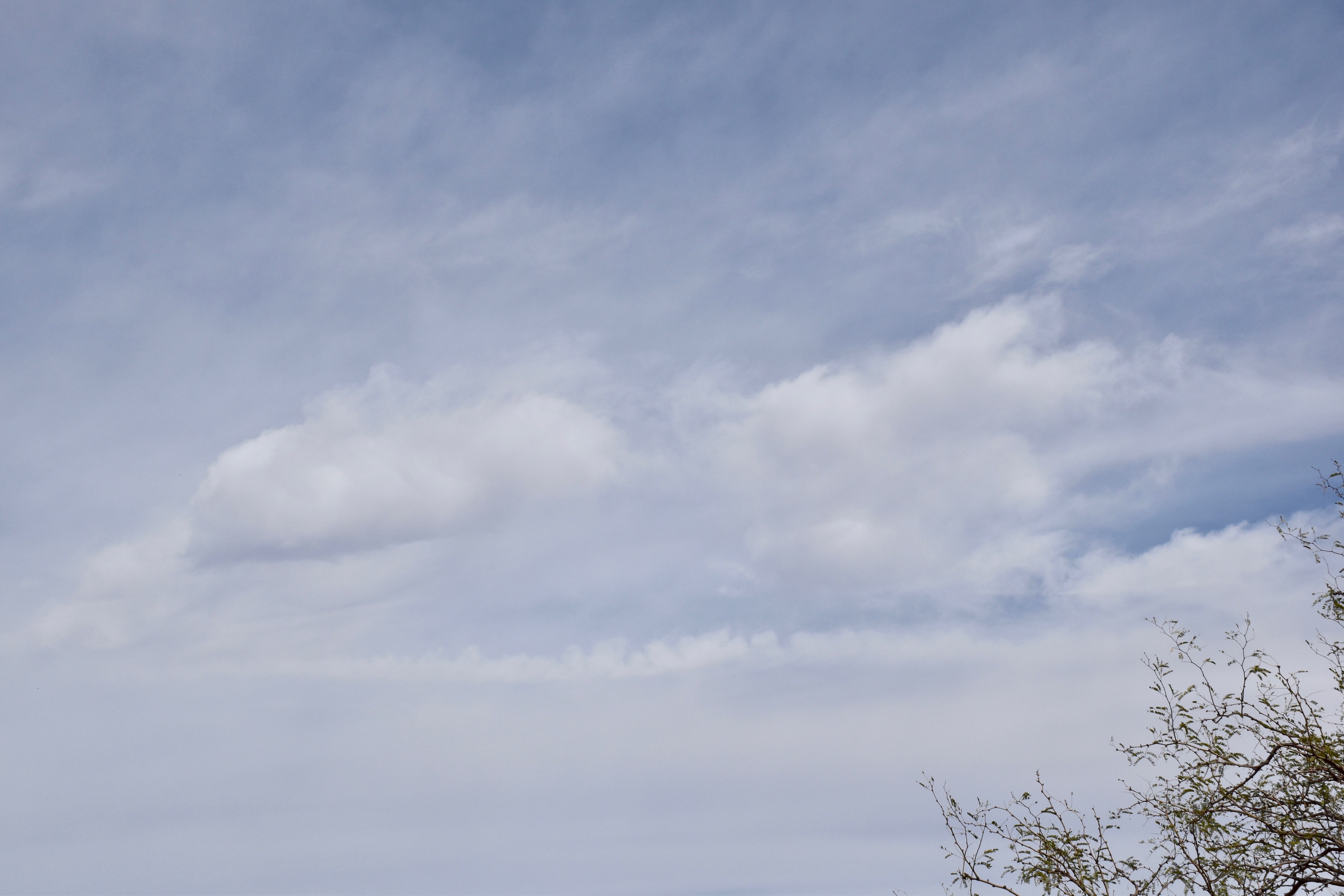
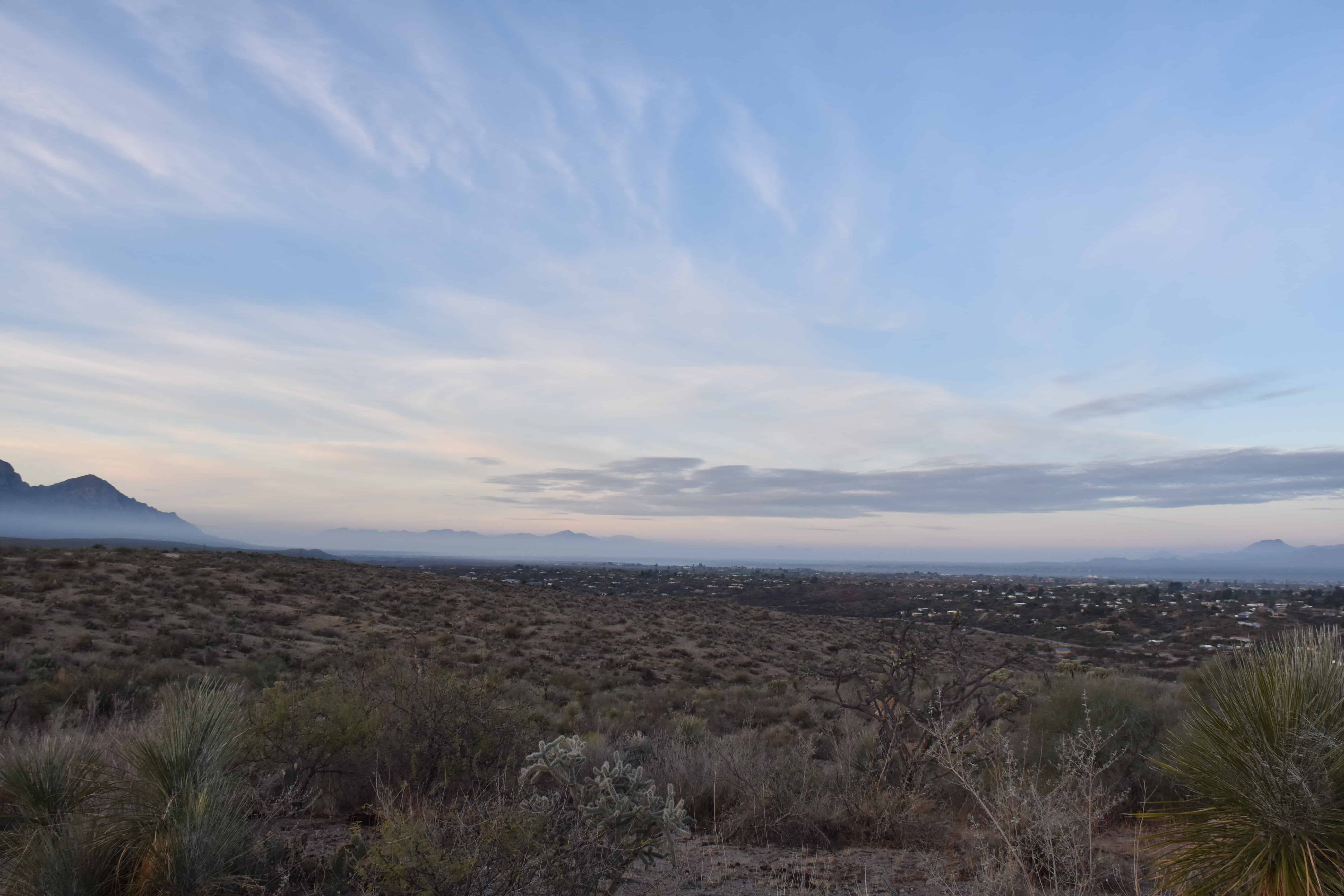
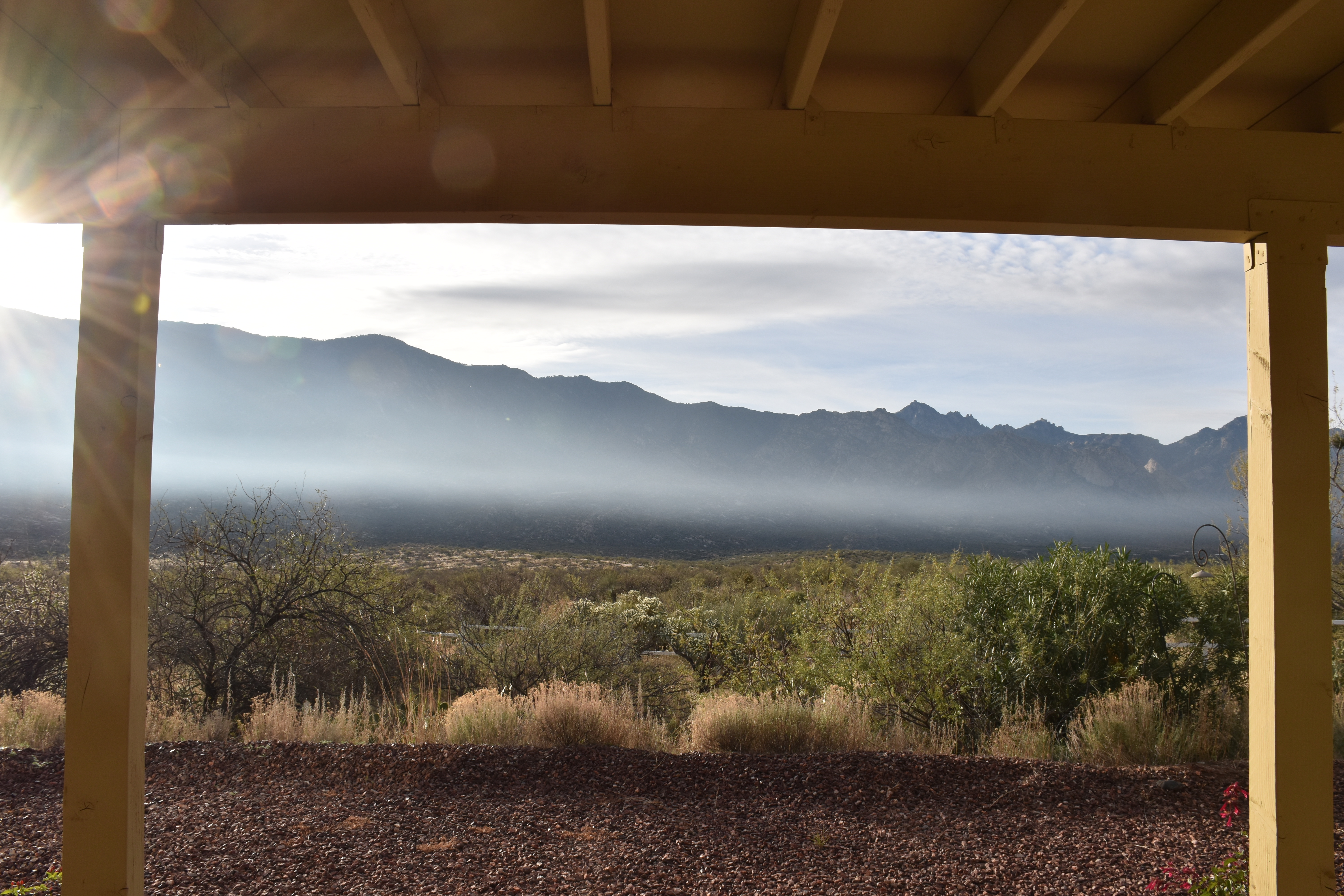
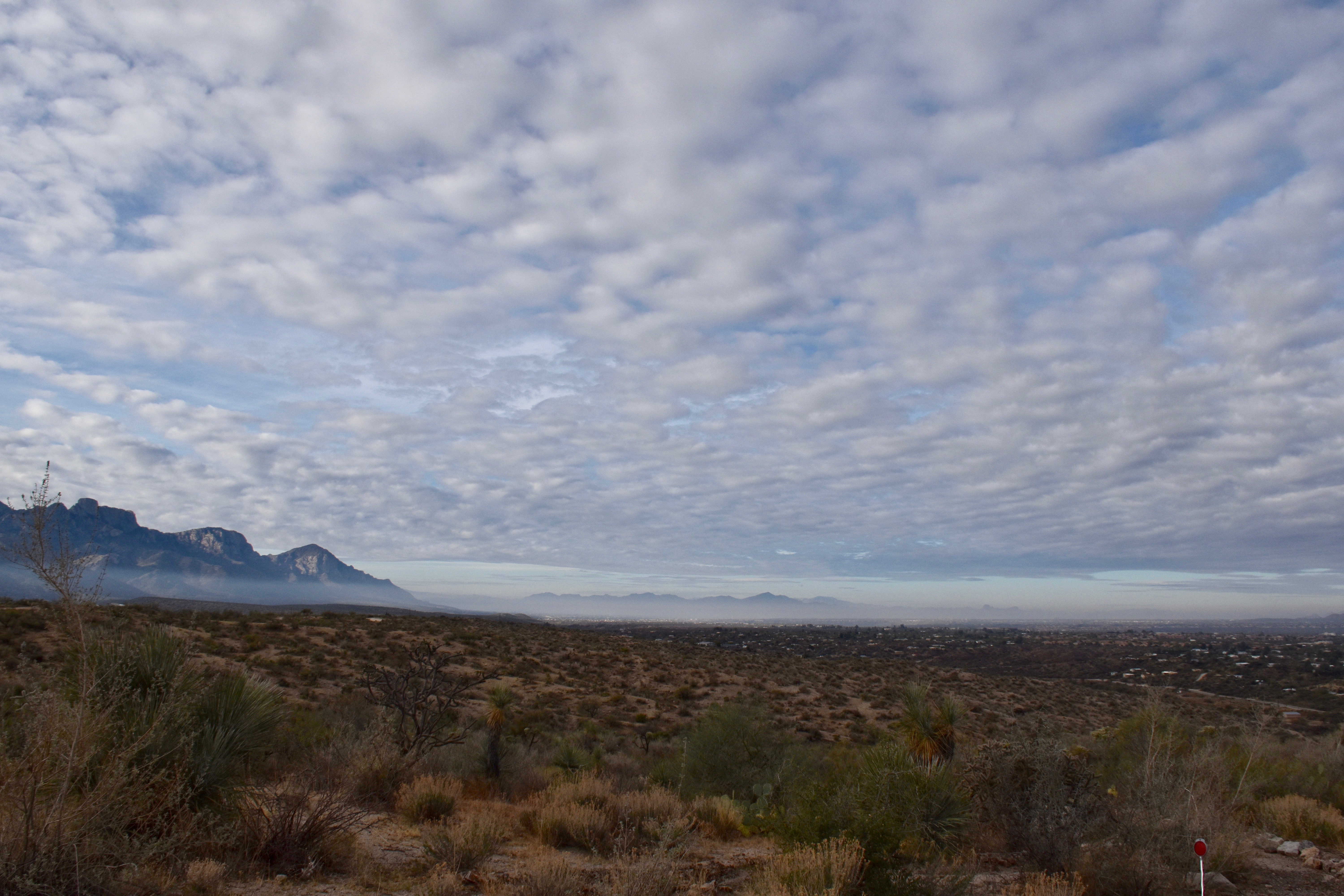
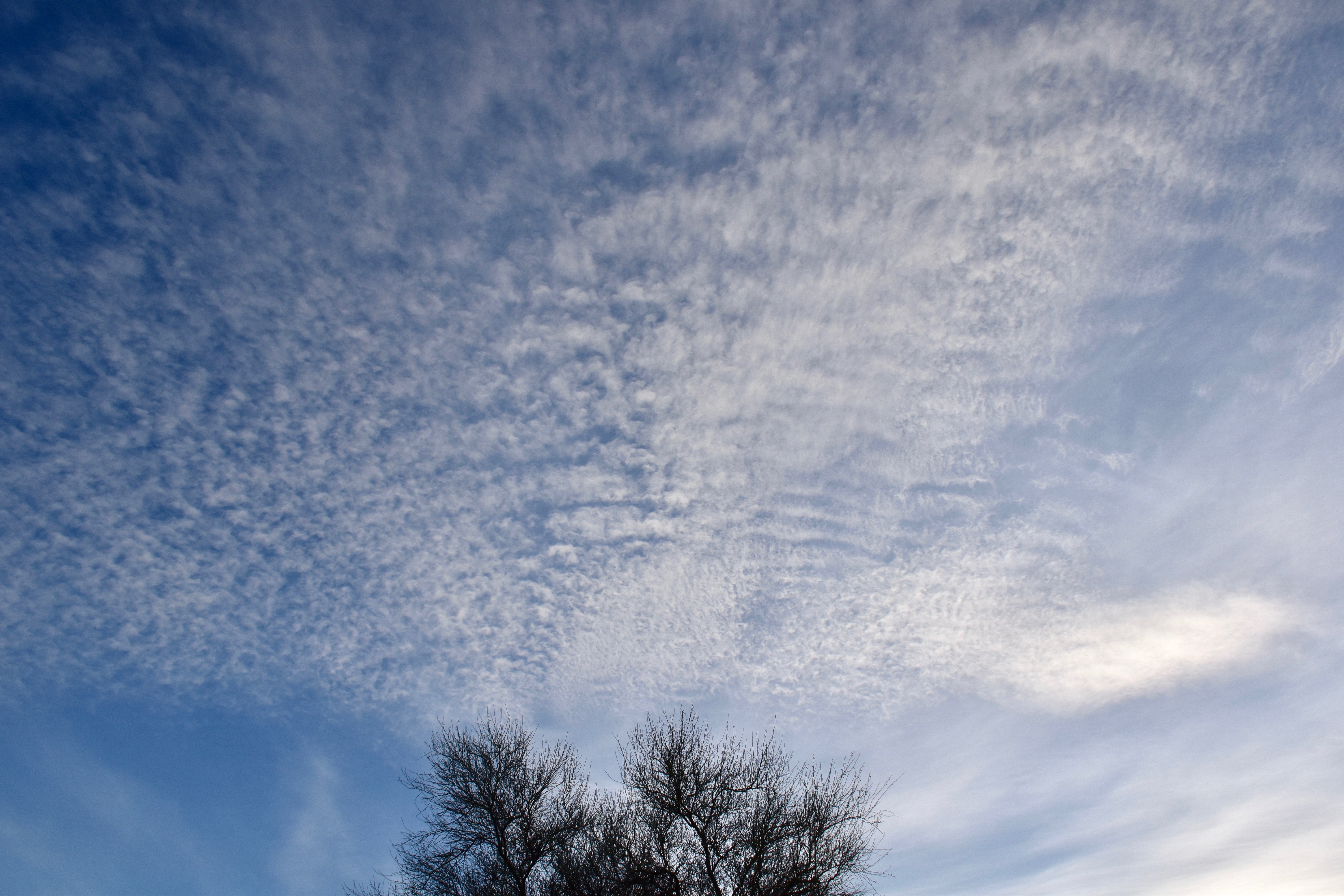
Huh, Sounds familiar. Well, 50 shades of gray is a theme here at cloud-maven.com. Those various shades brought 0.02 inches of rain this morning to The Heights. Here are yesterday’s 50 shades:
7:58 AM. Massive ice cloud advances on Catalina from the Tropics.
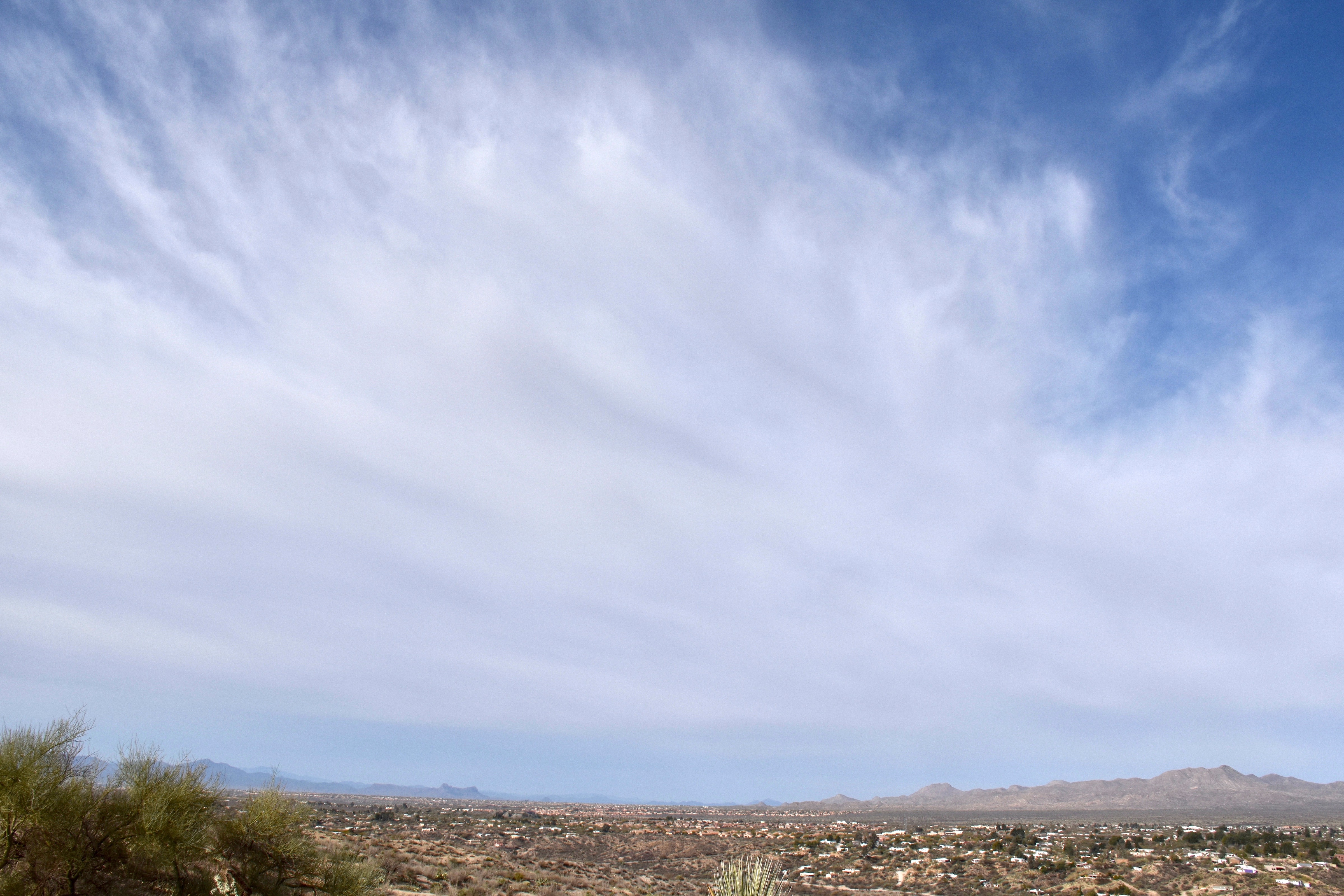
This Altostratus invasion covered the sky within about 15 minutes, and that was it for sun, except some “filtered sun” at times (when this layer is called Altostratus translucidus (the sun’s position can be seen). Its an all ice or mostly ice cloud.
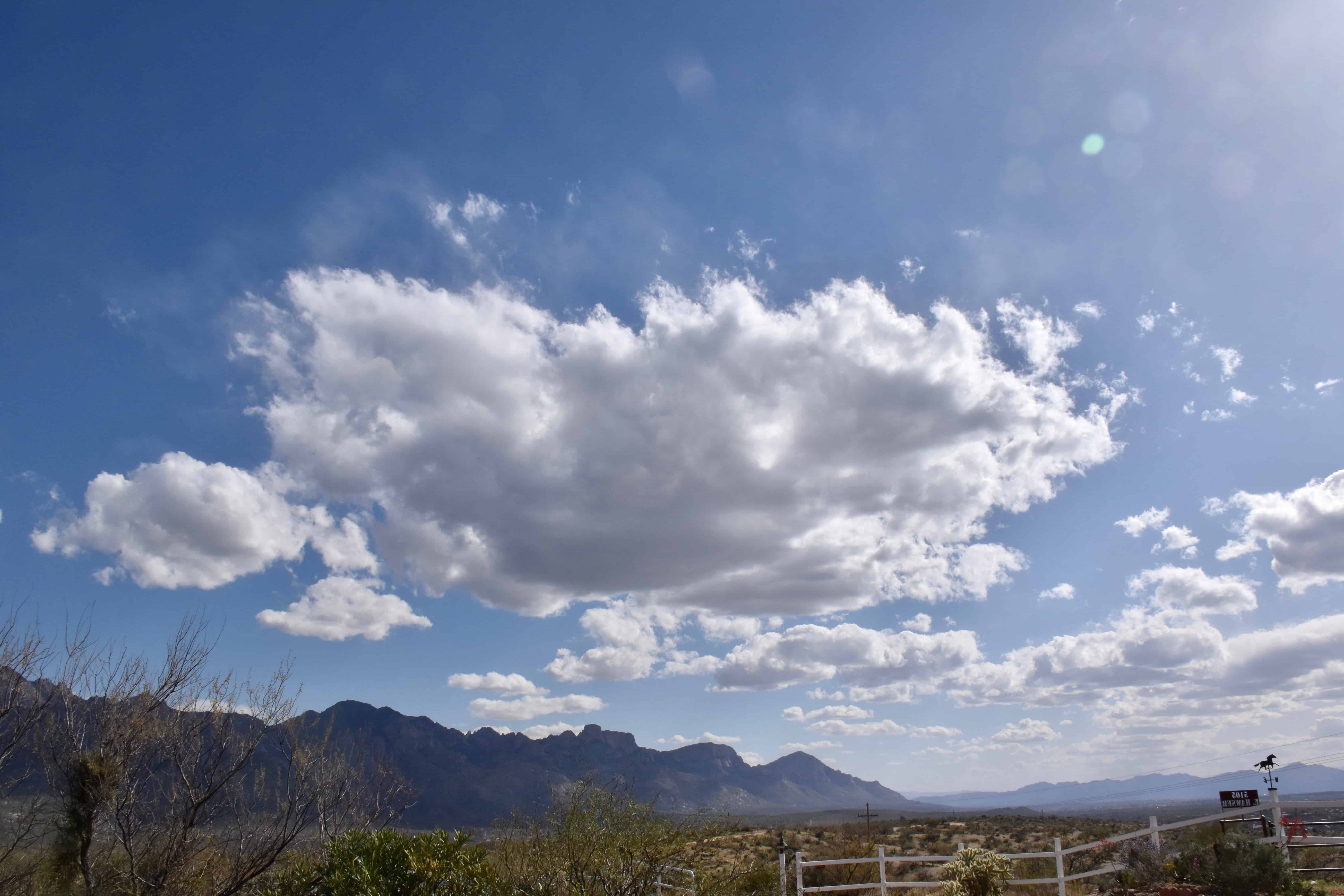
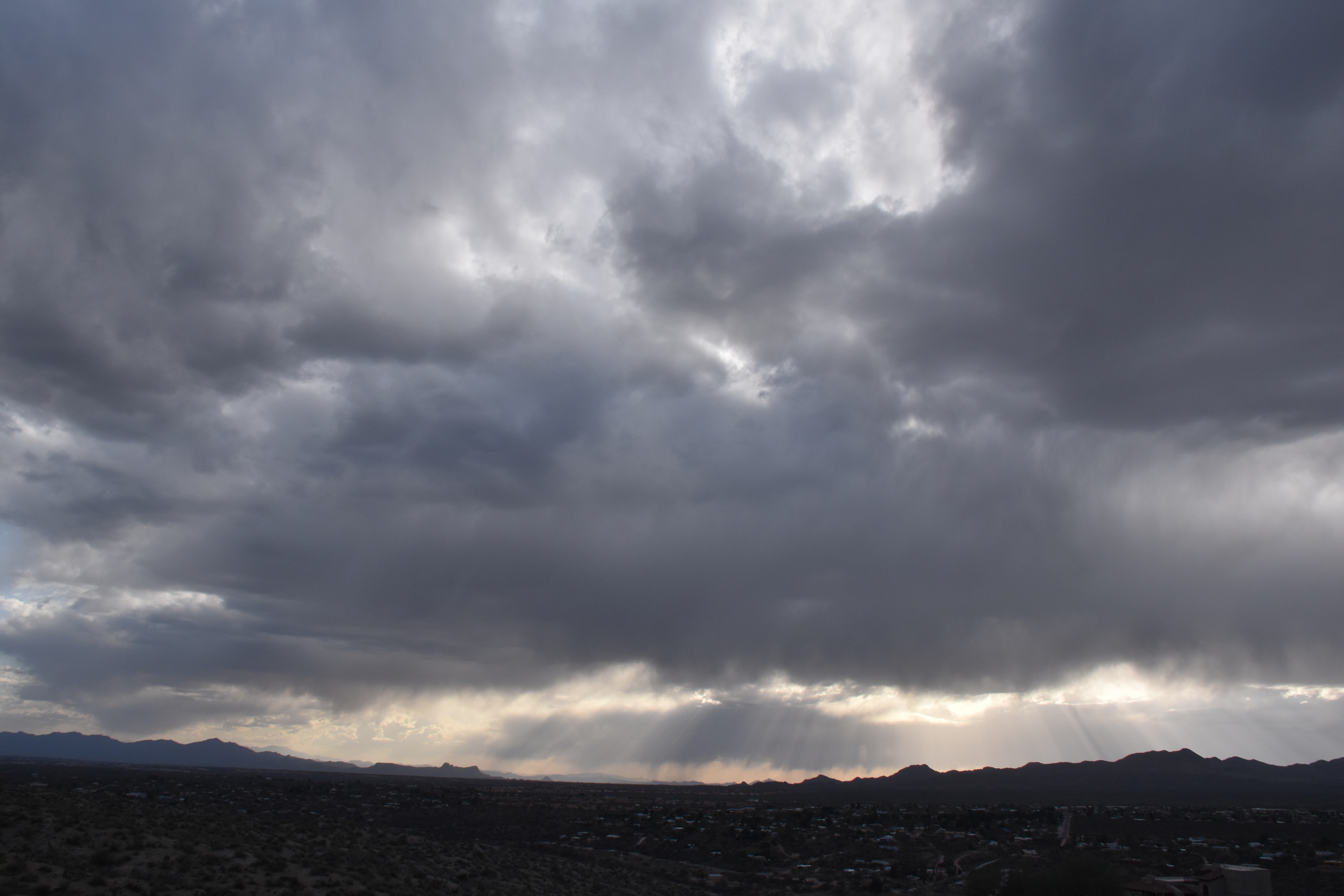
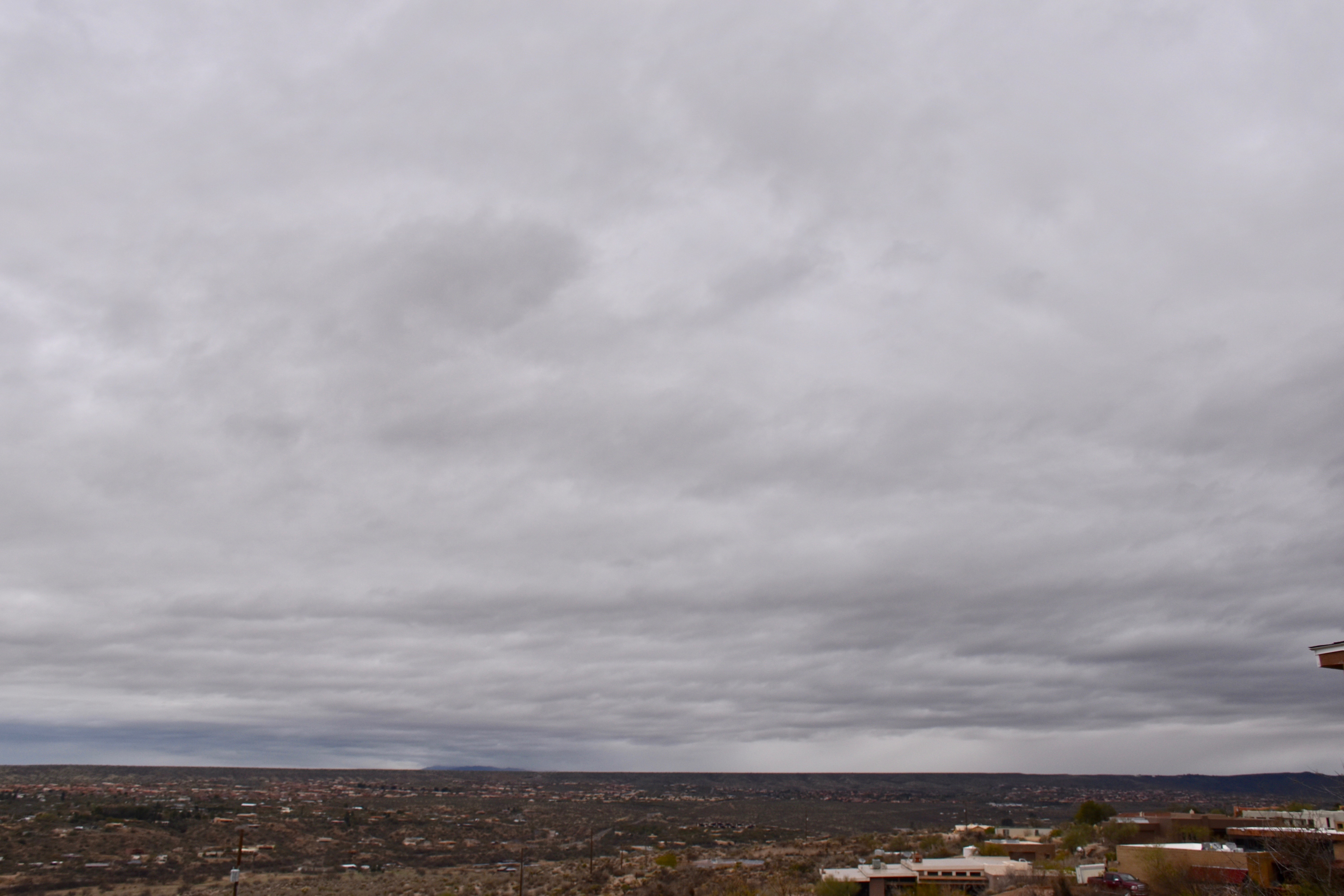
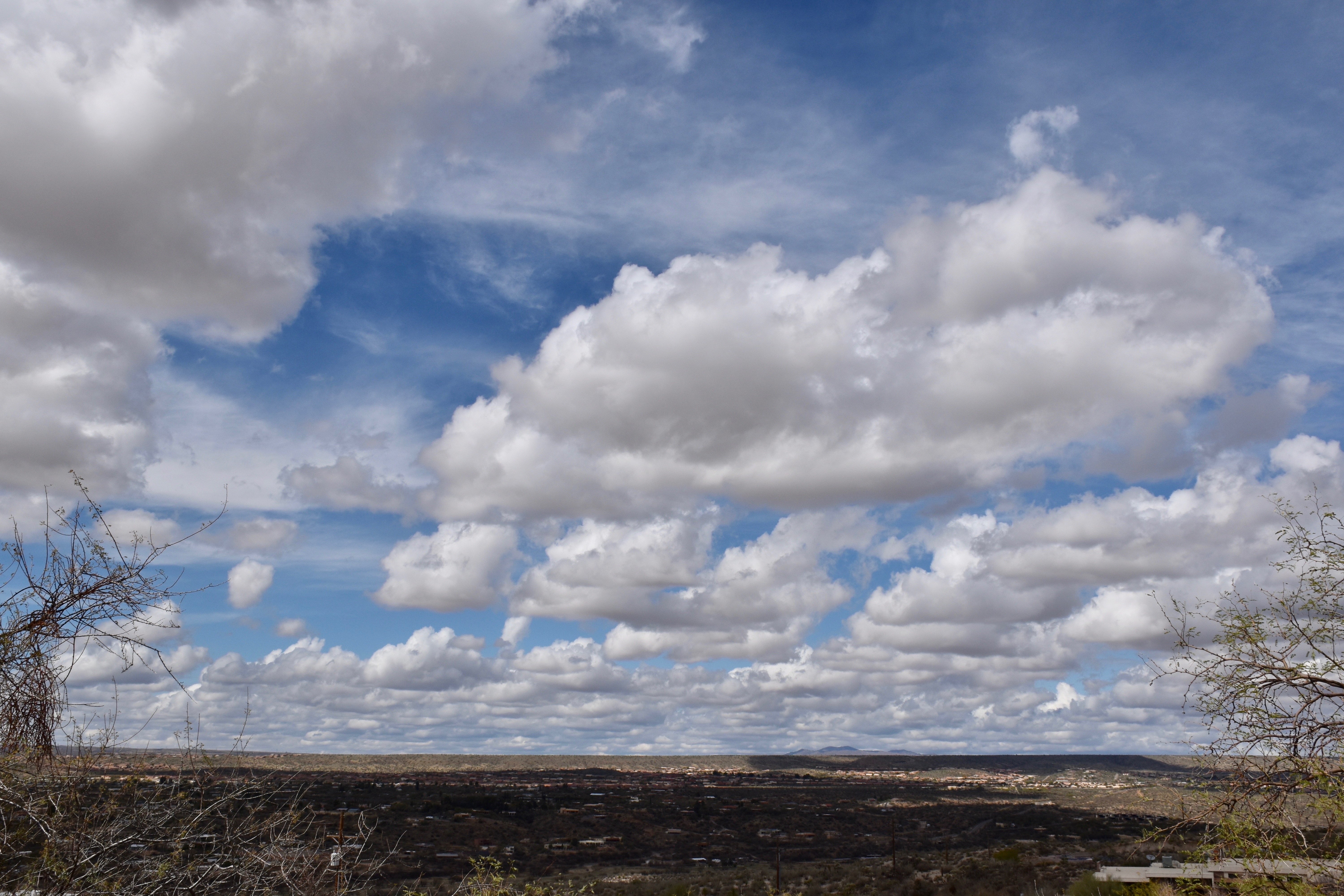
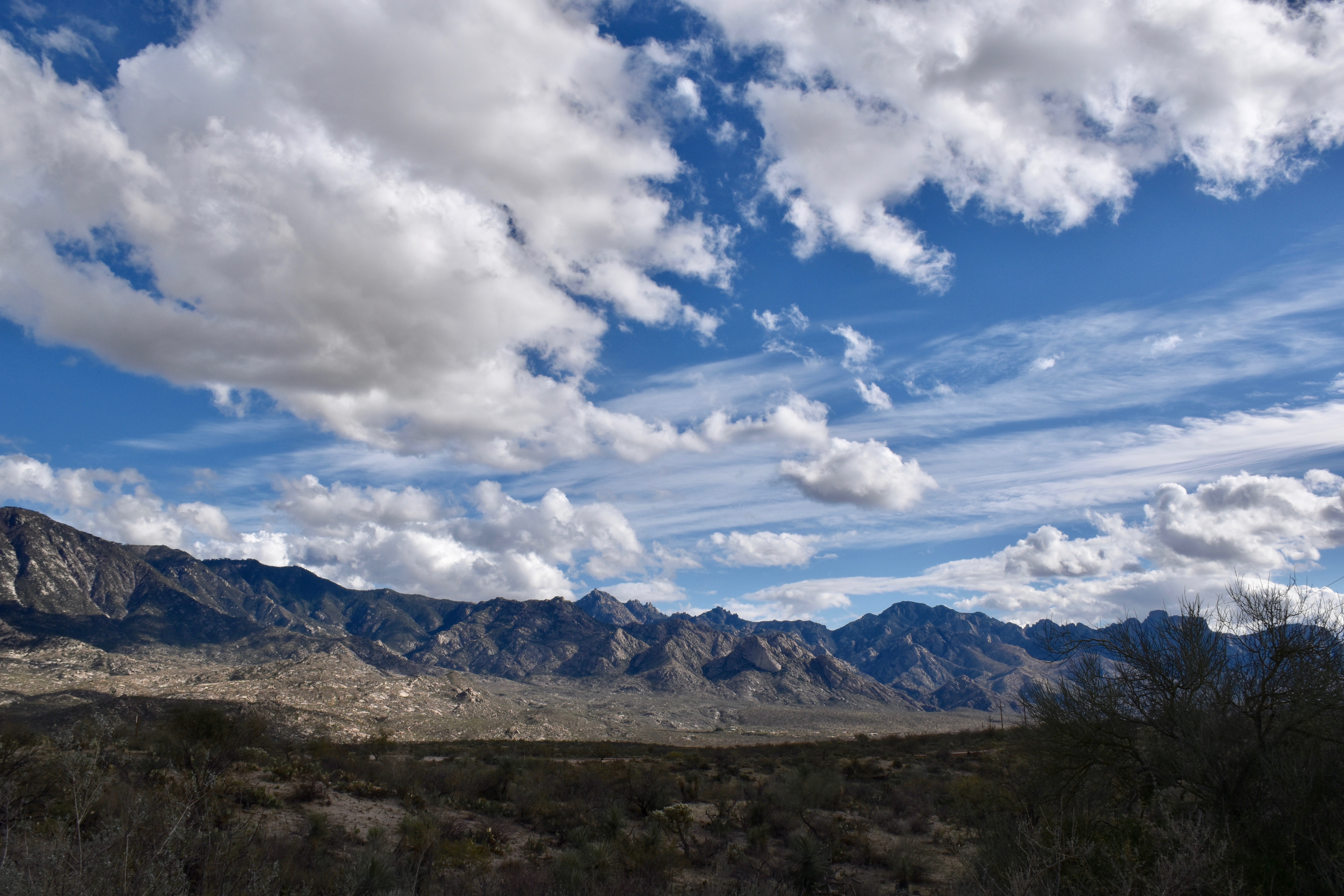
10:58 AM. Altostratus creates a pleasant gray sky.1:26 PM. Lower droplet clouds began to appear, high-based Stratocumulus. The globules are too large to be Altocumulus, though these were based at about 7,000 feet above Catalina, or a little above the height of Ms. Lemmon.1:26 PM. A UFO appears to be soaring toward Catalina with some kind with a trailing spider web. Other lenticular can be seen, this one was truly out of this world. But, from where? What world?1:41 PM. More lenticulars; more shades of gray.3:36 PM. Altostratus is now transitioning to Nimbostratus with lower bases as steady, but very light rain, moves in toward Twin Peaks. What you’re looking at here is mostly virga, and, as the relative humidity increases below virga bases, the virga is able to drop to lower elevations. The humidity is increasing due to gradually rising air that is accompanying an upper level trough. Got pretty wind about this time, too, before calming down. Not sure what that was from except maybe virga falling into very dry air ahead of the rain.3:42 PM. Classic look of Altostratus translucidus. “Opacus” (too thick to see the sun), just ahead. Those darkest areas near the sun are droplet clouds. Most of the scene is ice cloud.4:16 PM. Finally, as very light rain began to fall, we now see the most perfect view of Nimbostratus you’ll ever see. I hope you took plenty of shots of this scene cloud maven juniors! (Nimbostratus, the deep, deep cloud producing steady rain and snow is almost ALWAYS partly or totally obscured by lower Stratocumulus clouds so you can’t really see it. But, not here!
The weather ahead
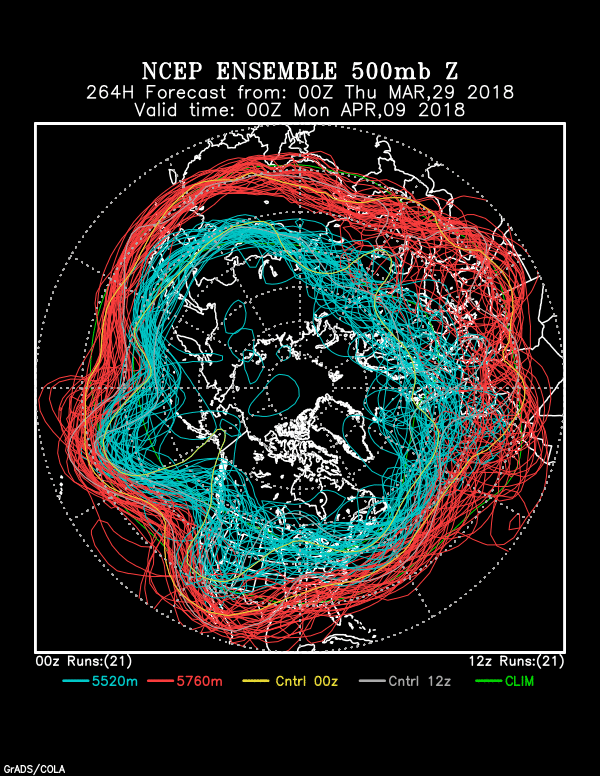
Pretty much a sure-thing rain (we, unprofessionally forecast at least a 90-100% chance of measurable rain then) will move in late on the 16th or on the 17th. Should be a significant, vegetation-boosting rain, too–by that I mean at least a quarter of an inch–unlike this rain this morning. It looks,. too, like a second rain might move in a day or two after that one. Quite strong support in the ensembles (“spaghetti plots”) for that to happen, too. How great would that be? Very great, of course.
After that, the models are showing even more troughs affecting AZ, but the ensembles aren’t sure about it. Neither am I (CMP).
High cold ones that are headed this way in a curvilinear path. Image was made at 5 AM AST, annotation later.
That means that a deep Altostratus overcast will be in place by tomorrow with a load of virga and sprinkles, not really much rain since the bases will also be cold and…high. Top possible rain amount from these high cold ones is a tenth of an inch, but more likely will be traces. Chance of a trace in the area? Oh, about 99% IMO.
But that’s not our full rain destiny.
On the horizon, only a week from now, is the likelihood of a significant rain. Check the models and the spaghetti:
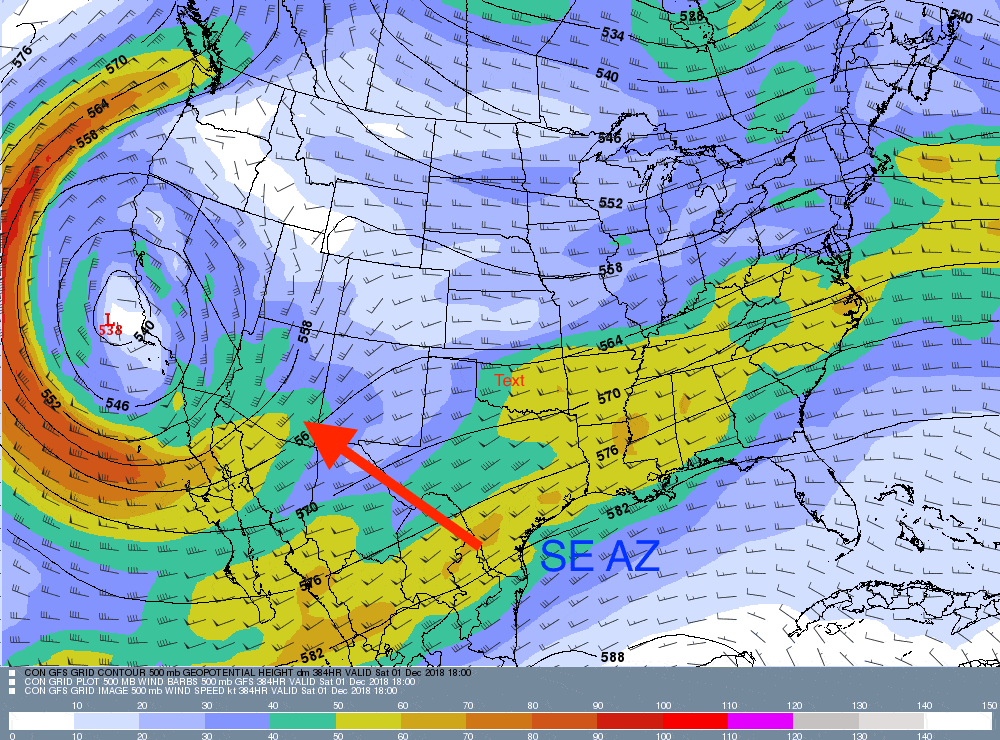
Valid at 5 PM AST, March 16th. You don’t need the precip prediction for this day when the 500 millibar pattern is like this, the core of the wind at that level south of Tucson. Its not a sufficient criterion for rain, but a necessary one in the cool half of the year. (Only about 5% of the rain in TUS falls outside of this criterion in the cool half of the year.
Here’s the rain prediction which I have not looked at until posting now to make the point you don’t need to look at it:
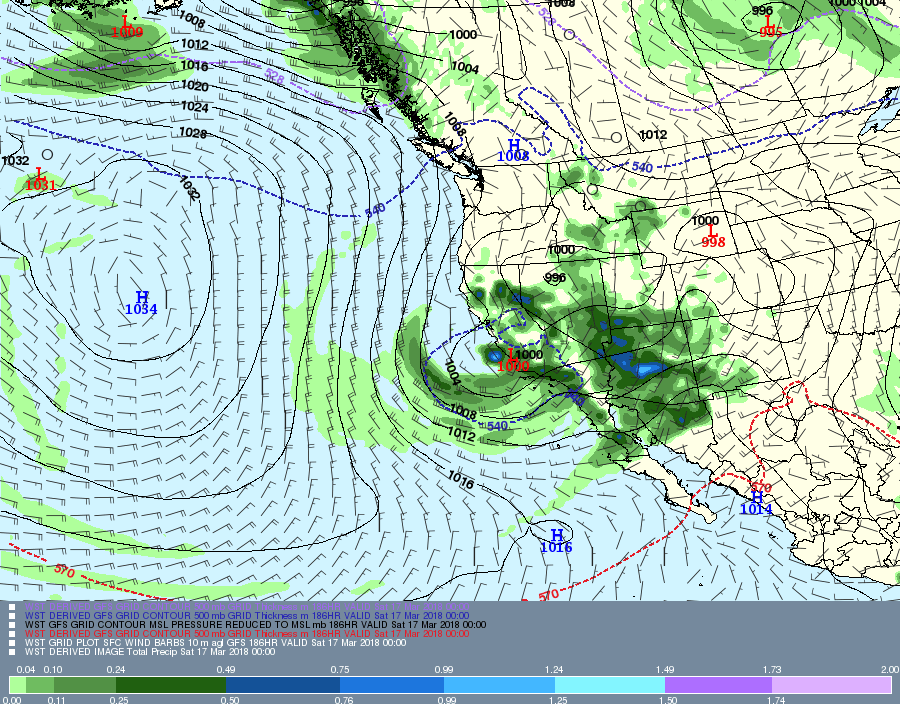
Where the model thinks it will have rained in the 6 h prior to 5PM AST on March 16th. I hope you’re happy now.Valid at 5 PM AST March 16th. Blueish lines of cold and rain (546 decameter geopotential height contours) way down the Cal coast, and somewhat bunched (confidence indicator) for a major trough to affect all of Arizona, keep the current greening underway.
Would say the chances of measurable rain from this “incoming” are at least 90%; i. e., virtually certain. (Note that “virtually certain” is not the same as 100% certain, but its damn close.)
Problems with hoster and connections to hoster continue–must wait seconds to see what I’ve typed, then have to go back and correct the gibberish. So, not doing much as a result.
But here are a couple of cloud shots from yesterday anyway:
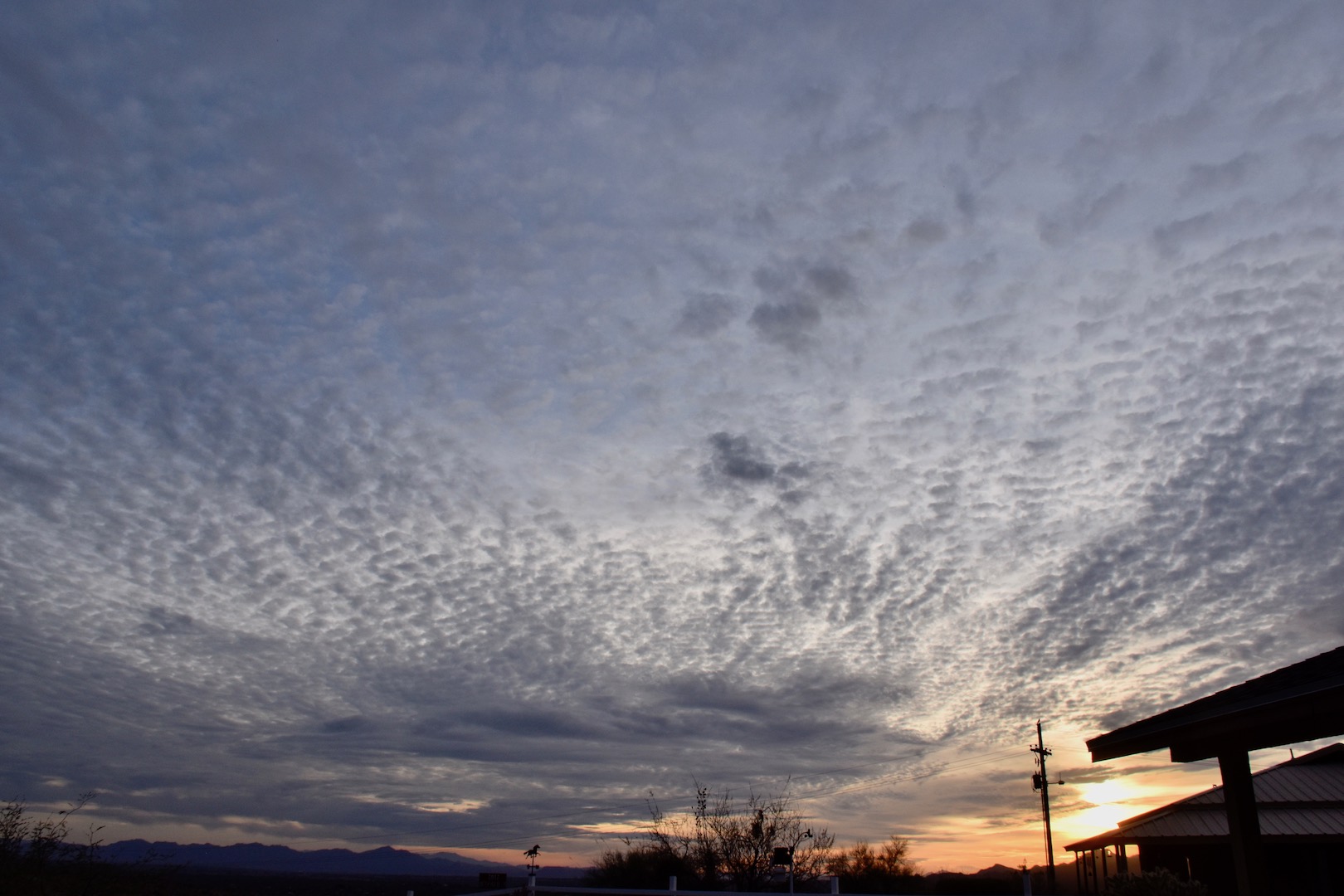
6:17 PM. Altocumulus perlucidus appearing to spread out, though likely a perspective tomfoolery. Thin Cirrostratus above.6:39 PM.
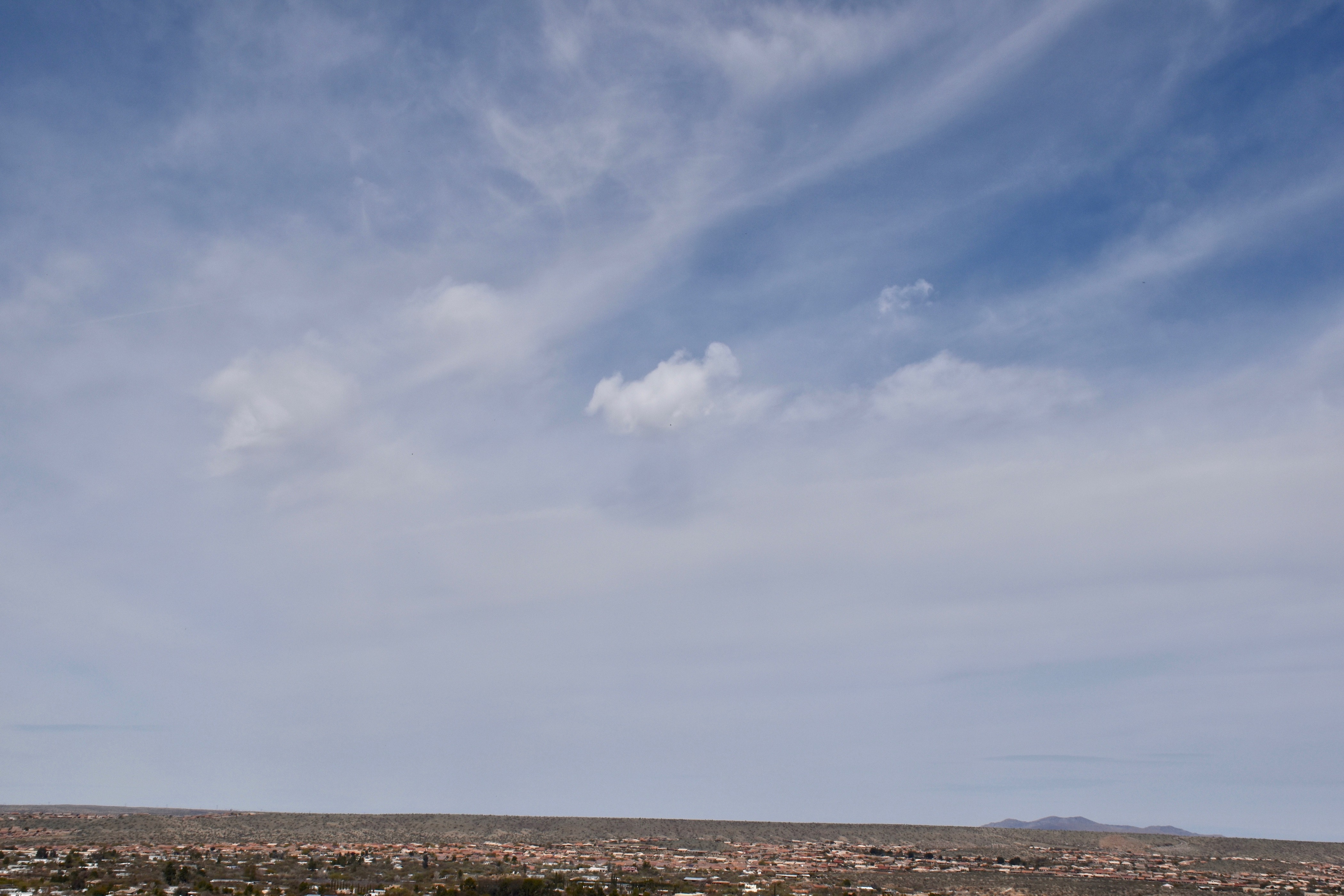
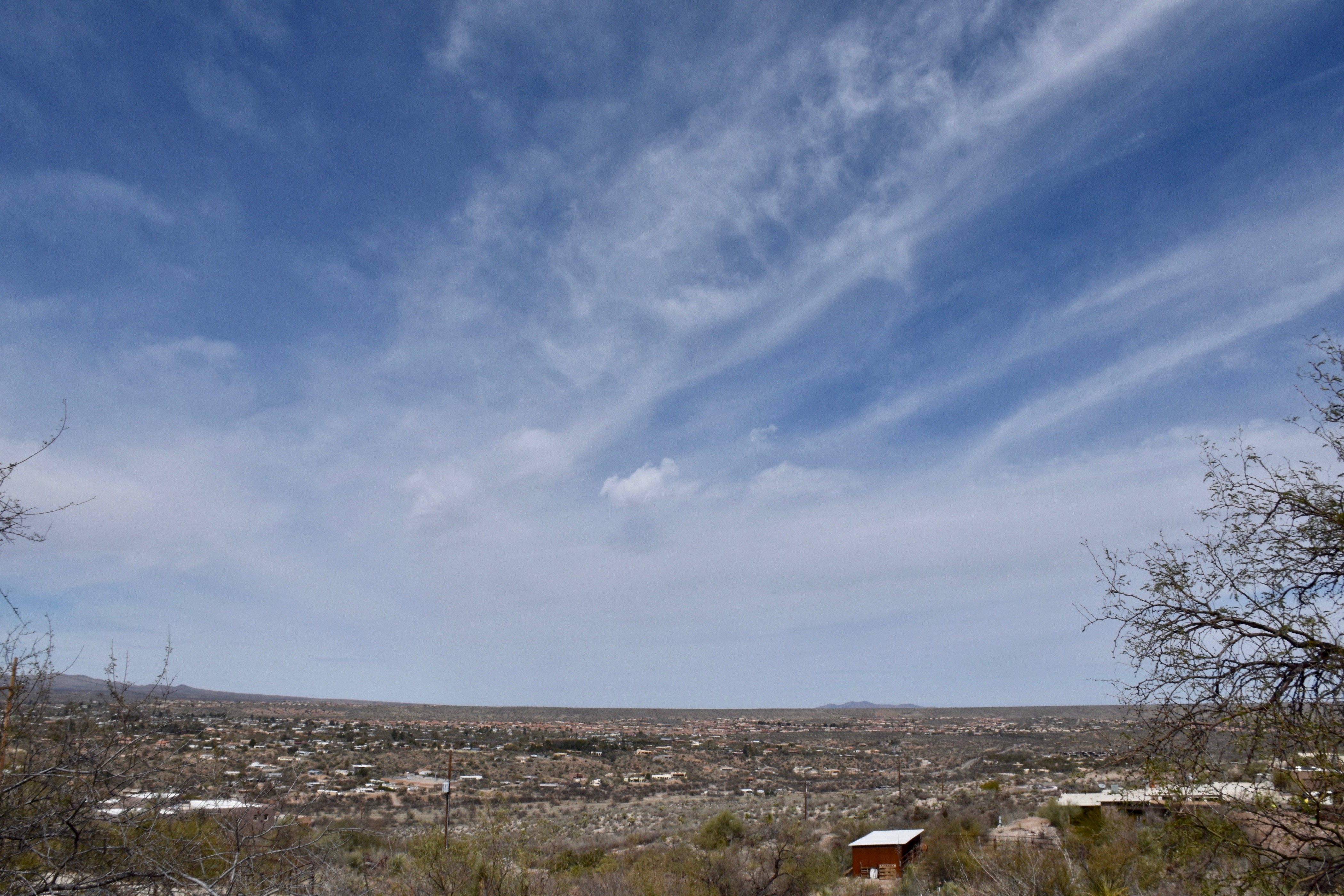
Addendum: Coupla of days ago saw the rare “Cumulo-cirrus” clouds, ones that appear to be Cumulus but are fakes, up at Cirrus-levels. You might call them Cirrus castellanus. I feel these are worth sharing so that the young cloud maven person doesn’t embarrass himself or herself when making a cloud call to friends and neighbors, as you would do. They occurred on March 7th between 11:30 AM and Noon. Can you tell, upon “zooming big” that these are mostly ice clouds? If droplets were present they were there for only a short time, thus (is that still a word?) indicating that these rag clouds were at very low temperatures.
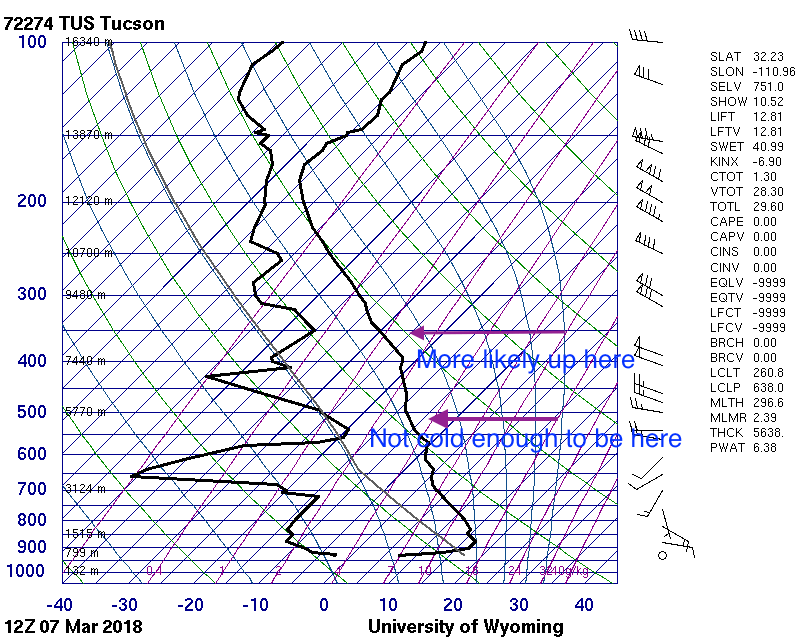
Some sounding detective work below
The 5AM AST sounding for March 7th. The sliver of moist air at 16,000 feet above sea level is not deemed the source of those rag clouds.5 PM AST, March 7th sounding with writing on it.
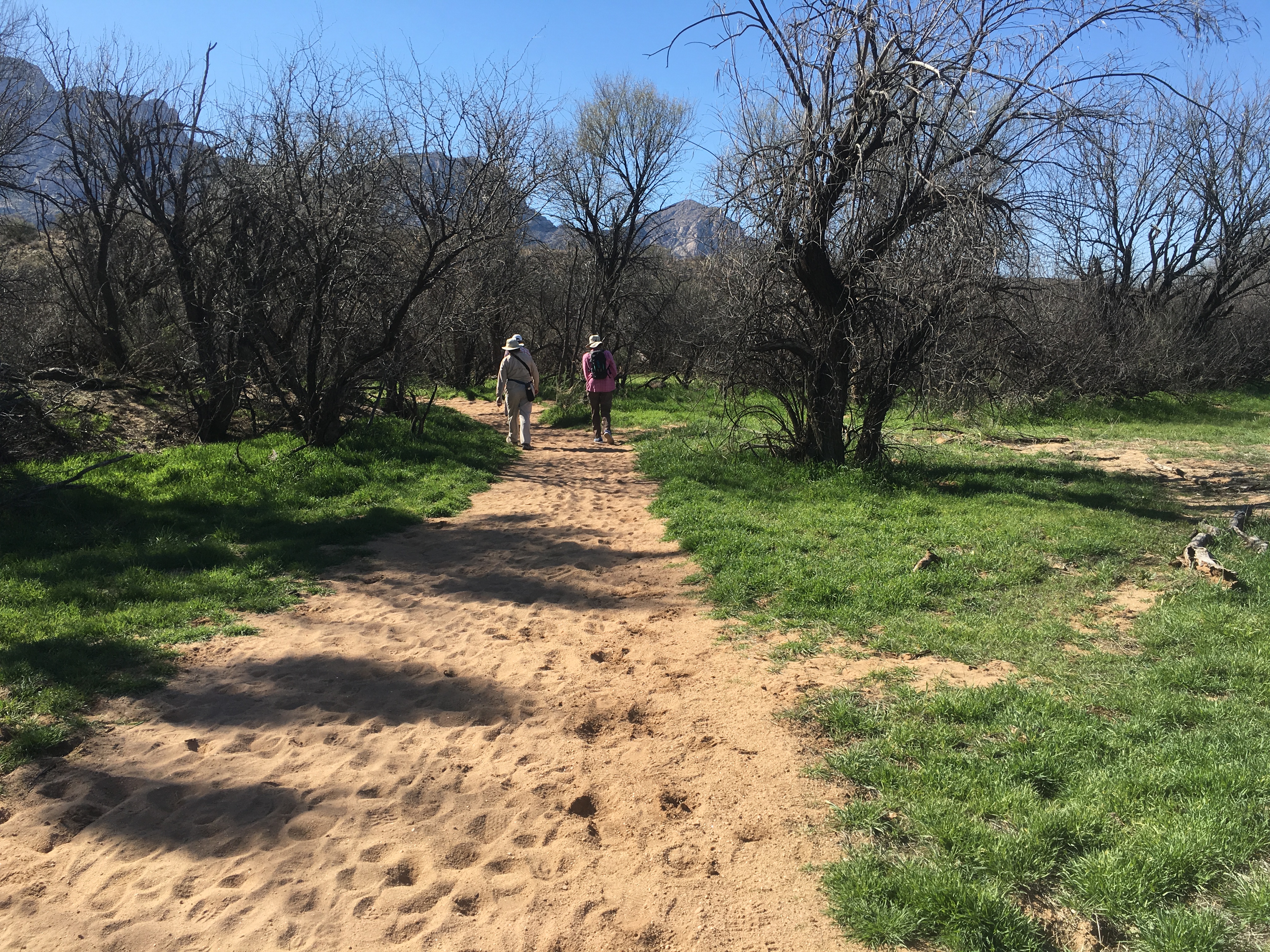
Its not a review of a new Stephen King movie where people turn green after eating too many vegetables. Its a status report on growing grass as of yesterday from a hike.
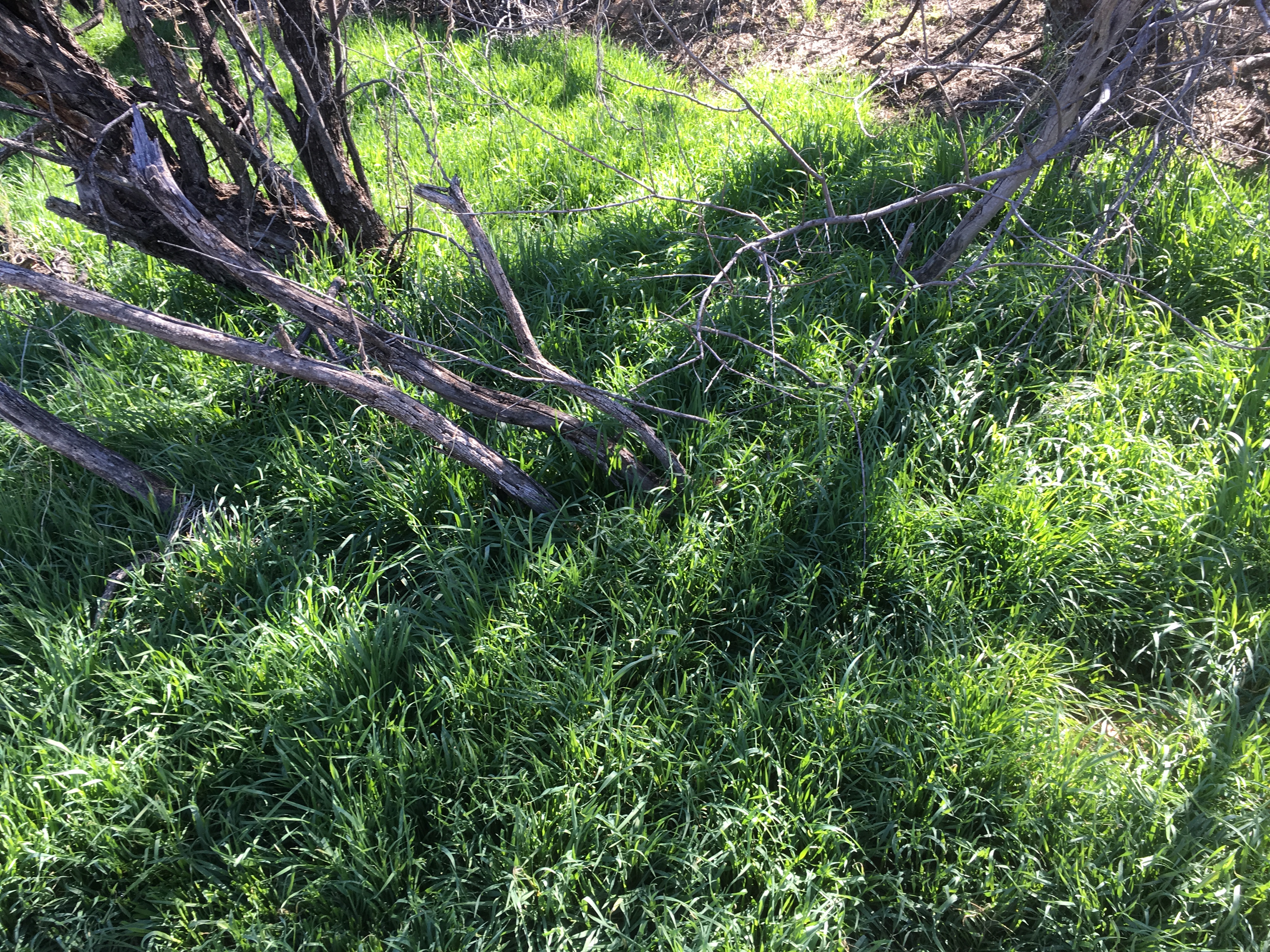
Got pretty excited yesterday watching grass grow. Below, some exciting examples of growing grass, mostly from the flats around the Canada del Oro wash near the Catalina State Park entry building, in case you’re thinking about rushing down yourself to see grass grow. Some areas are not so far along (last photo).
Nice to see this eruption of green after our 2 inches or so of rain recently. Even saw a couple of poppies popping up by the entrance to the Park.
Chance of measurable rain here in Catalina? 100% (IMO).
While these photos popped in in a rather timely manner after changing ISPs, typing text remains an unsolved buggabo; must wait several seconds to see what’s been typed, making any writing, such as it is, a real debilitating slog. Thanks for sharing my pain.
The weather way ahead
Doesn’t look so great for more rain after this upcoming event. The ensembles (spaghetti plots) show the trough bowl we are in now retrograding to offshore of the West Coast. This will be great for droughty California, but downstream over the SW will be a ridge leading to a long dry and warm spell as this regime change takes place after our rain.
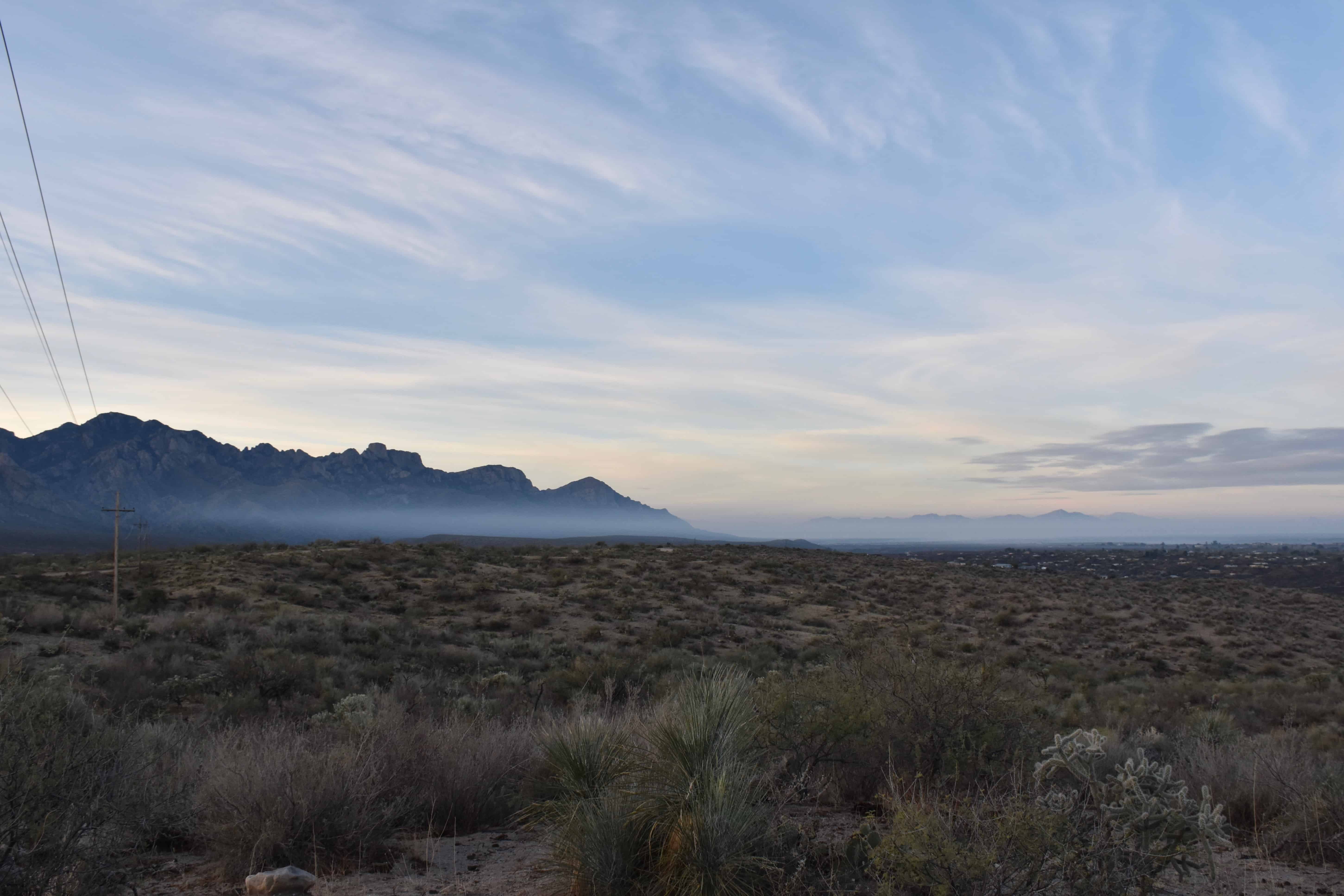
One branch of a seemingly bifurcated plume, spread north along the side of Samaniego Ridge. The other branch appeared to moved out of Tucson to Continental Ranch, “thence” northward toward the east side of the Tortolita Mountains. It’s happened before, but is pretty rare, maybe once a year occurrence.
(Took an hour for these first three jpegs to be uploaded to WP, btw.)
7:23 AM.7:25 AM.7:25 AM.8:16 AM. Smog plume at its maximum northward extend along Samaniego Ridge, Sutherland Heights area, before dissipating.7:49 AM.8:58 AM. Stratocumulus perlucidus races toward Catalina.7:59 AM. Altocumulus translucidus perlucidus undulatus, quite a cloud-filled mouthful.5:30 PM. This rain shaft is strong enough that one could suspect a weak Cumulonimbus cloud has erupted from the Stratocumulus.
Quitting here due to slower than dial-up service, hosting service, “godaddy” has confirmed its not them….
Have cameras ready for interesting clouds today as yet more storms approach. Winds at 500 mb (around 18,000 feet above sea level) are forecast to approach 100 kts by tonight (oops, TOMORROW NIGHT! Egad). With winds like that, likely will be some nice lenticulars around to add to your collection. Oh, I already see one downstream of the Catalinas….
Maybe some photos later if the upload problem can be resolved.
Its not resolved…. But, trying to look at the bright side, while this ONE photo was uploading, I got some more coffee, read a book (Cadillac Desert, Marc Reisner, and got a good start on, Mythical Rivers by Melissa Sevigny–both highly recommended for cloud maven readers.
6:27 PM AST last evening, though after the brutally slow uploading speed to WP, maybe its not the same day as I started this upload anymore….
Some more on the upcoming rain and wind event in the next 24-36 h:
From this keyboard, 10% chance of less than a trace (pitiful forecast), in other words, a zero from this storm, and 10% chance of more than 0.40 inches. The average of those two, which helps center a forecast in the forecaster’s mind, great or small, would be, say, 0.21 inches.
But the wind max during this storm event will be the most “interesting” part of it: 10% chance of puffs less than 35 mph, 10% chance of more than 65 mph , in this forecaster’s opinion. The average of those would lead me to think that very momentary gusts will reach 50 mph (averaging those extremes to center a forecast). So, the wind in the next 24-36 h is really the most interesting thing to keep an eye on; stuff will blow around, shingle fragments likely to come off. This is NOT a NWS forecast.
The End
——————— 1“Puffs”: almost instantaneous blasts of a few seconds.
Toot, toot, drip, drip. Rain fell on Catalina, Arizona, for the third day in a row, bringing our three day total, at least in Sutherland Heights, Catalina, to 2.18 inches, and over NINE inches at Ms. Mt. Lemmon, subject to quality control later.
Here’s a nice map, courtesy of the Pima County ALERT network, whom I haven’t actually asked to post this but you can go here and see it in the original:
The three day totals for the Valentine’s Day starting storm of February 14th, of course, through the 17th, 4 AM to 4 AM AST. The map has been enhanced with a total over that time period from Sutherland Heights for comparison.
Yesterday’s clouds
No photos, still suffering from WP or godaddy hosting chokehold. Even text takes seconds to appear! Worse than dial up. The above jpeg, just 1.4 mb, took several minutes to upload!
The weather way ahead and soap-boxing the erroneous, “warm temperatures” expression
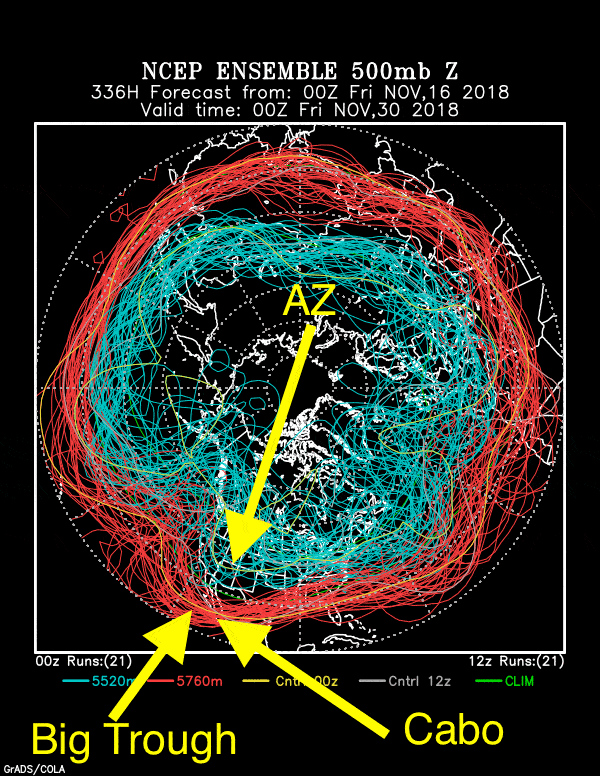
While the NOAA ensembles let us (me) down in mid-January when it appeared that troughs would dominate in late January through early Feb (it wasn’t even close to that interpretation, and the first time I’ve seen those crazy plots do so badly, will go with them now and present a couple that strongly suggest the drought pattern has been decimated for Arizona and the Southwest; no more weeks of no rain or rain threats, with ridiculously warm days (note, not days with “warm temperatures”, a temperature is a unit of measurement, not a thing that can be cold or warm—-got it? Its the AIR that’s warm or cold, or a day, a month. What if, when a high pressure sat on Arizona, that I said we had really “dense millibars today”, to make a comparison showing how WRONG it is to say, “warm temperatures.” Its HIGH temperatures or LOW temperatures, etc. Tell your friends….
OK, will go through that bit more of uploading misery with these stupefying spaghetti factory plots. Inspect them and be happy if you like unsettled weather, storms threatening or actually occurring every few days. The first one is a week from nows, then ten days from now, and the last one two weeks from now. Exult over the troughulent regime we’re now in! Yay!
Note how the red and blue lines dip southward over the whole southwest US. That dip represents the location where upper air troughs will be occurring at this time. The red lines are more or less the periphery of the jet stream on the warm or tropical side, and the blue lines nearer the heart and cold side of the jet stream.
This “ensemble” approach, where tiny errors are deliberately input into the model data as the computer run begins is deemed one of the great advances in forecasting, this due to more powerful computers that can crunch so much global data so fast. There are always errors in the data, and we can’t measure the atmosphere over the whole globe in an instant, and this is a way of determing what the errors might do to the forecast. Heck, we don’t even know what the real errors are. So we input some and see what happens.
The greater the effect errors have, the more spread out and chaotic the patterns are. When the red and blue lines stay close together, it indicates that at least, tiny errors, don’t have much effect. Normally, after ten to 15 days, the lines are kind of a mess, with only general patterns discernible. (Sure is annoying typing and waiting seconds to see what it is you’ve typed!)
In last evening’s global data runs, the red lines in our domain stay pretty bunched up, indicating a strong indication of troughing over these next two weeks, even out to 15 days! So, cloud maven person is pretty excited thinking that maybe a wildflower or two can now pop up, and our spring greening will go forth.
Just yesterday on a dog walk to the Sutherland Wash, tiny plants were bursting forth from the ground. What a miracle that is. (The wash had no water in it.)
Sutherland Heights total as of 5:34 AM (tipping bucket): 0.90 inches! No way was this much expected from this keyboard. Looks like the rain is going to continue for a few more hours, too. Just terrific! Update: 1.21 inches in CoCoRahs gauge at 7 AM!
Catalina Area
0.87 Golder Ranch (Horseshoe Bend Rd in Saddlebrooke)
1.26 Oracle Ranger Stn approximately 0.5 mi SW of Oracle
0.94 Dodge Tank, Edwin Rd 1.3 mi E of Lago Del Oro Parkway 1.34 Cherry Spring, approximately 1.5 mi W of Charouleau Gap
1.38 Pig Spring, approximately 1.1 mi NE of Charouleau Gap
0.94 Cargodera Canyon, NE corner of Catalina State Park
0.79 CDO @ Rancho Solano, Cañada Del Oro Wash NE of Saddlebrooke
0.71 CDO @ Golder Rd, Cañada Del Oro Wash at Golder Ranch Rd
Santa Catalina Mountains
1.42 Oracle Ridge, Oracle Ridge, approximately 1.5 mi N of Rice Peak
4.06 Mt. Lemmon, Mount Lemmon
1.42 CDO @ Coronado Camp, Cañada Del Oro Wash 0.3 mi S of Coronado
1.02 Samaniego Peak, Samaniego Peak on Samaniego Ridge (looks low)
3.03 Dan Saddle, Dan Saddle on Oracle Ridge
2.20 White Tail, Catalina Hwy 0.8 mi W of Palisade Ranger Station
0.83 Green Mountain, Green Mountain
1.97 Marshall Gulch, Sabino Creek 0.6 mi SSE of Marshall Gulch
Let us look noew at the precursor clouds from yesterday:
Sorry, no images. It took more than 2 h to upload several images yesterday, and now, as also has happened since downloading the latest version of WP, several seconds before I see what’ve typed!
This has been going on for weeks and weeks, ending the fun in blogging.
Will be spending the next few weeks either moving to another hosting site, blogspot, or figuring out why WP has become unusable (again).
We often have phony dramatizations suggested by titles with exclamation marks, and frankly, today is no exception. I do like Cirrus, though. Hope you do, too.
Why like Cirrus1?
They provide a lot of nice sunrises and sunsets. EOM.
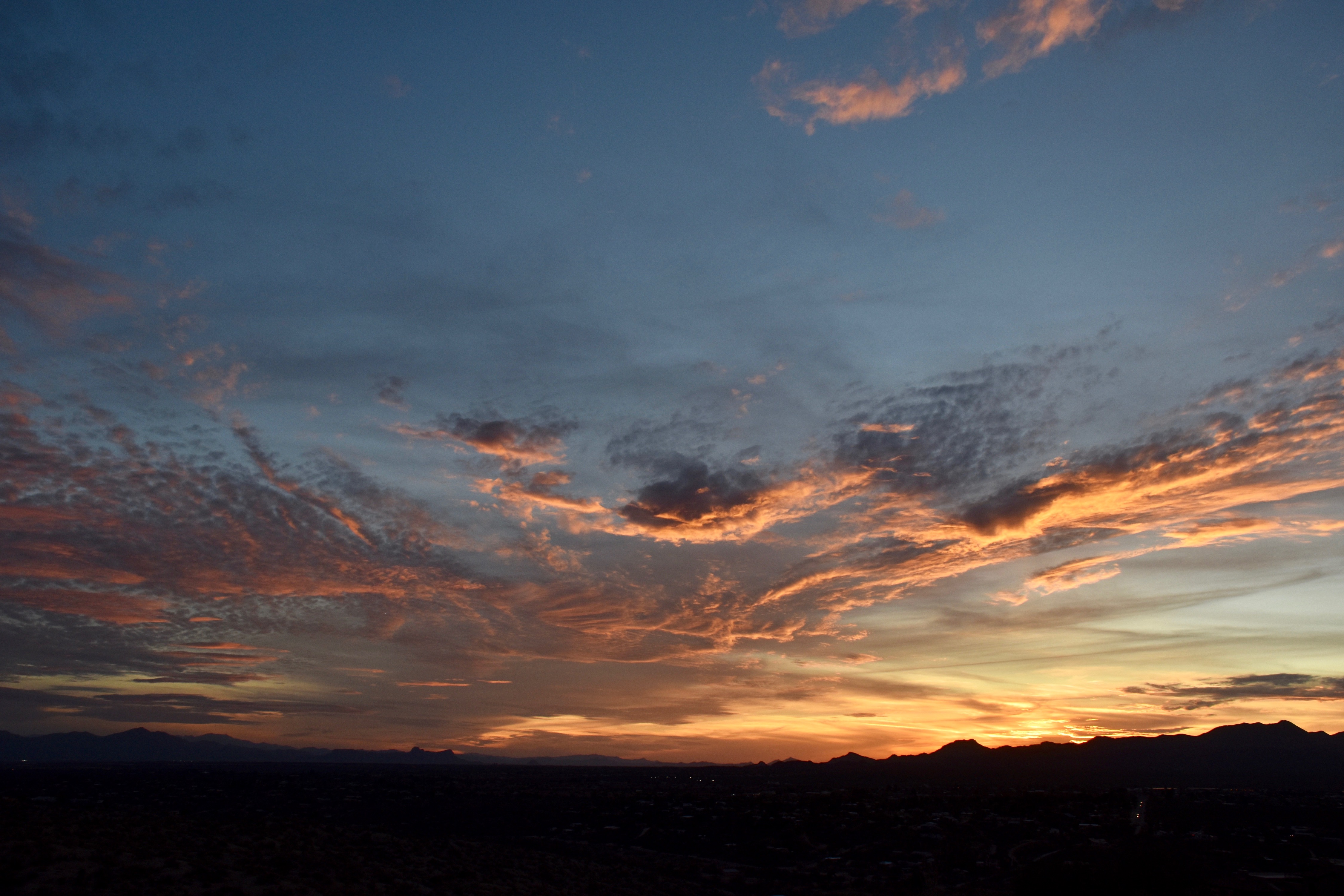
Example of a recent CIrrus sunset, FYI.An example of a recent display of Cirrus at sunrise.
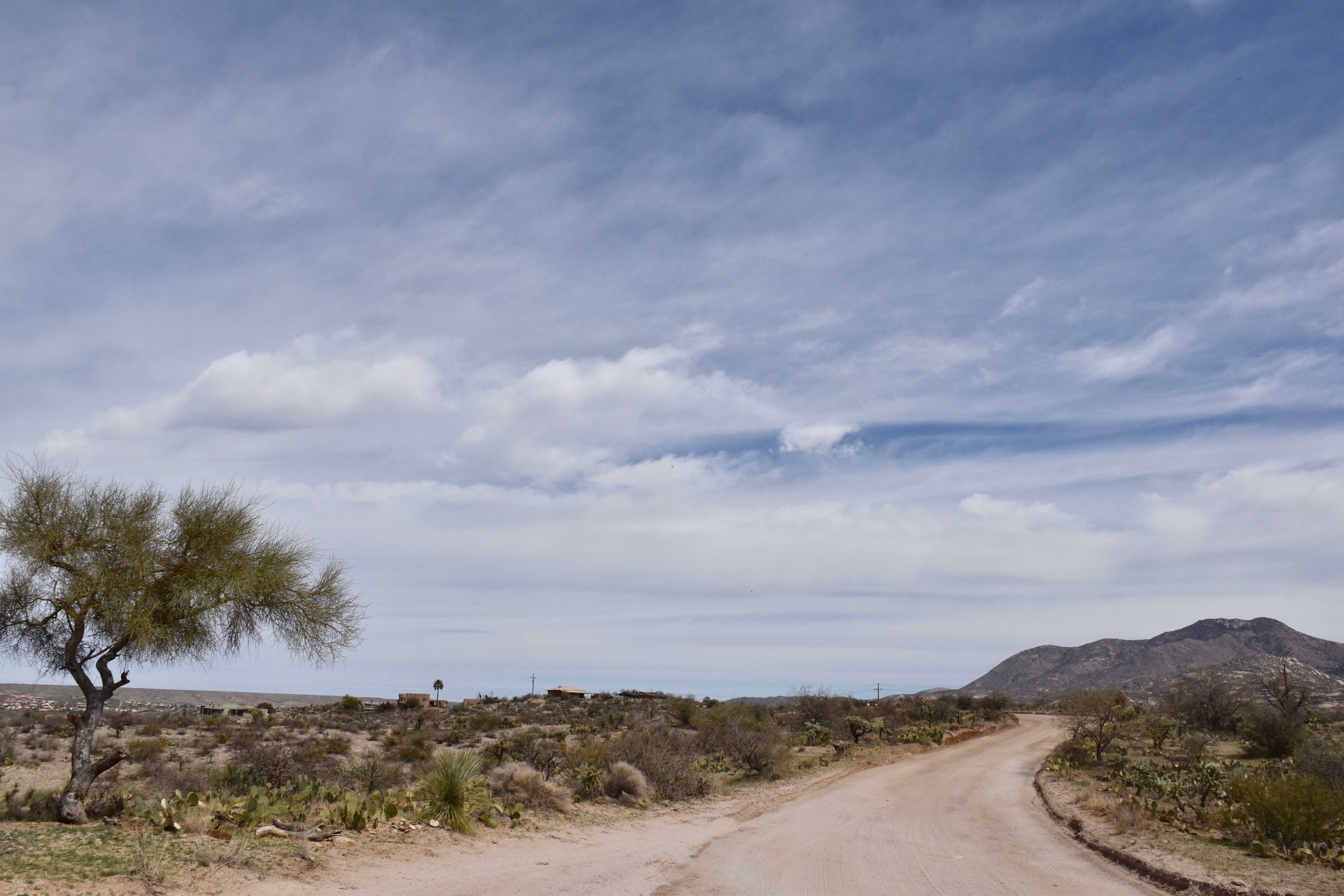
Yesterday’s displays of Cirrus, ending with a scruff of Cumulus toward Pusch Ridge:
7:29 AM. Cirrus castellanus, or what we sometimes call, “Altocumulocirrus” because it looks so much like just Altocu.
At least 0.02 inches, as deduced from this keyboard–haha. Should be more than that, but, in a rain of drought, everything seems to work against getting a major rain. Raindrops will possibly begin as early as 12:02 AM on February 15th, though probably not. Maybe a day or two later if a tropical insertion of moisture around a low passes east of Catalina. In that case, we’ll have to wait for the Pacific polar air to reach us near the center of that upper low as it drifts eastward.
What is certain is that clouds will once again present themselves in great quantities over our skies in just a few days. The colorful sunsets and sunrises that visually spoil us with so much splendor will return, too, after being mostly absent over these past weeks of drought.